Monday, December 31, 2012

Happy New Year


I can do no better on this new year’s eve than to offer as blessing and guidance for the work we do this quote from Rene Dubos’ The Wooing of the Earth, as commented on by Russell Sanders in his book Staying Put:

“ ‘Ecology becomes a more complex but far more interesting science when human aspirations are regarded as an integral part of the landscape.’ This intimacy is crucial… it arises out of a sustained conversation between people and land. When there is no conversation, when we act without listening, when we impose our desires without regard for the qualities and needs of our place, then landscape may be cursed rather than blessed by our presence.”

But many of us are listening, and are eager for a deeper conversation. We find not just the promise of health and welfare in fitting ourselves well into the landscape, but goodness and spiritual uplift as well. So despite the hardships, we look forward to the work ahead.

May our hands and hearts be strengthened by each other and the tasks we, together, undertake.

Wednesday, December 26, 2012

Awakening Awareness

My son's friend, Sam Arbesman, opens the second chapter of his wonderful first book, The Half-Life of Facts, with what is no doubt a legendary story about a legendary man, Derek J. de Solla Price, the father of scientometrics*. (Stay with me here. This will be more fun, more interesting and easier than you think.)

In 1947, Price was asked to hold for safekeeping about 200 volumes of the Philosophical Transactions of the Royal Society published annually between 1665 and 1850 in his apartment til the renovations of the library that owned them were done. Pressed for space, Price did what most of us might do and laid them along the wall of his apartment in neat yearly stacks in chronological order. One day, while musing about this or that, his eye settled on this mass of books and noticed that their piles created a design that looked something like this:

The shape was not random, but rather resembled a curve that demonstrated exponential growth, that is something not just growing, but growing faster and faster as time goes on. I can only imagine Price saying what my son tells me can be heard at the beginning of almost every great discovery: "Huh. That's funny."

Curious about what this shape might mean (if anything) Price went on to explore the pace of scientific discoveries as evidenced by articles published in other scientific journals and, well, the field of scientometrics was born. What this means is what the book is all about. That is not my interest here.

My interest here is in the moment of awareness. Price had been living with this curve for a while before it awakened in him this "huh" moment. I have broken spaghetti hundreds of time without ever wondering, and potentially discovering, certain truths about tensor analysis that the physicist Feynman mused over when he made pasta.

Which is to say - there is not just mystery all around us but portals to answers, evidence about life's elegant machinations, hints about loved ones' feelings and desires, peeks at how and why people behave the way we do that are willy-nilly lying about just waiting to be noticed. Truths hiding in plain sight.

Jewish tradition tells us that one of the things that made Moses a remarkable leader was his attentiveness to detail. What does it take, we are asked to imagine, to notice that a bush on fire is not burning up? How long must one stand there, or how often must one come back to check? It takes attentiveness, alertness, curiosity and caring. These attributes lead to discoveries, great and small. And such discoveries often lead to life's most rewarding knowledge, patents, progress, advances as well as understanding, love, familiarity and intimacy.

So it is precisely in the midst of our daily rounds, in those moments of mindless routine when we are least expecting novelty and excitement, that we just might be visited by visions of "Huh". I hate to think how many such visions I have missed, overlooked or otherwise squandered over my lifetime.

The good news is there are many more out there. Now that I know, I hope I am ready.

*the discipline of the study of science

Tuesday, December 25, 2012

When we were newly-weds, my husband and I engaged in a rite-of-passage that was, even then, falling out of practice. We acquired a set of sterling silverware. This was not the kind of set you register for and buy piece by piece. This was a set we bumped into at an event that was somewhere between antique dealer and flea market. It was a simple, pre-assembled, elegant set but incomplete. Its service for twelve was missing almost all its serving pieces and a random place piece here or there. But it still had most of its dinner knives and lunch knives, soup spoons, teaspoons, bouillon spoons (or were they sherbet spoons), dinner forks, lunch forks, dessert forks, one fruit spoon, and one 2-tine butter pick.
our silverware

And then we did what most people do with their silverware - we wrapped it in special cloth and put it away for special occasions.

But as any silver maven will tell you, that's the worst thing you can do.  Dormancy allows the silver to absorb moisture and harmful "air" that hasten its tarnishing. The best way to keep silver shiny, presentable and bright is to use it, often. (And then wash and dry it well.)

Still and all, we put it away and opted to use our "everyday" flatware for our daily needs. Somehow, over the years, our everyday teaspoons have been disappearing. From a set of twelve we now have seven, which  means more often than not when we go to reach for a spoon, there are no clean ones left. I have been moved, therefore, to raid the "good silver" set to supplement our daily set.

When I first took out those singular spoons and an occasional fork, they were looking a bit unhappy and dull. But the more we used them, the more beautiful they became. Use burnished their shine.

Which taught me what in fact we somehow already know to be true: we must regularly use the best of our gifts, our moods, our manners, our civility, our dreams in our daily affairs if we want our lives, over time, to reach their fullest lustre.

As with silver so with our spirit. Routine use allows us to reveal its greatest lustre. We cannot save our polished selves only for special occasions, or favored people or dress-up times. If we do, we become stale, our manners become creaky, our kindness and generosity stiffen.

And after a while of regularly intentionally, consciously reaching for the better elements of our souls, those acts of goodness will become habit. Not a bad way to live our lives.


Wednesday, December 12, 2012

Last Chance

While this is not earth-shattering, consequential or otherwise notable in the affairs of world peace, it is kind of humbling, reminding us of our fleeting mortality.

Today, December 12, 2012, otherwise known as 12.12.12, is the last day for a century that all three numbers of the date - month, day and year - coincide.

For those of us who pay attention to the quotidian as well as majestic world of numbers, we have been spoiled, blessed these past 12 years with the gift of once a year writing this trifecta.

Enjoy today. Make notes and date things as much as you can.

Chances are, you won't get to do it again in your lifetime.

Tuesday, November 13, 2012

Today's report

This morning, the Green Hevra (the budding national Jewish sustainability roundtable dedicated to education, advocacy and action) presented at the Jewish Federation of North America's General Assembly (affectionately referred to as the GA).

We spoke of the greening of the American Jewish community, city by city and program by program.

So much to talk about and so little time. Plus - only 30 or so folks came. A most disappointing showing.

Still, the work is inspiring, the progress is amazing and we are fired up to make the 2014 GA - which is said to be in DC - the year when green goes mainstream.

Fall 2014 is the start of the next shemittah (sabbatical) year.

We will have LOTS to say about this over the next 24 months - so keep on the lookout for shemittah developments.

In addition, a wonderful website overflowing with "greening" resources was unveiled today by Jewcology:

It was created in conjunction with a site called On1Foot. You can find the environmental pages here.

It has materials that you can read, download and manipulate into your own lesson plans and resource sheets.

Take a tour, a little walk-around - learn, enjoy, share.


Friday, November 9, 2012

Kindling

It is a ritual this time of year - I walk around the yard and pick up kindling that is strewn here and there. The ground is yielding a particularly rich harvest this year, what with the derecho and Sandy.

For most of the year, though, I ignore the fallen twigs, sticks and woody debris that lay scattered on my lawn. At best I would trip over them, or find them piled up at the edge of our woods, dumped there like so much waste by our lawn company. But this time of year, as the days get colder and the nights get longer, and my stove wants to be fired up, they become gold.

They are the bridge between the match and the blaze; the cold and the light.

And they teach me about how we measure "worth," and our prideful - or perhaps shameful - sense of waste.

As I seek out, and pick up these fallen limbs, one by one til my arms are full and my home secured with kindling for the next day, I wonder what else of value I miss in my daily wanderings.

What other gems have I overlooked because I have been too rushed, too focused elsewhere, too set on my narrow sense of what I needed now. Even more, what have I determined to be "waste," worthy of nothing more than to be swept aside, piled up and dumped somewhere out of sight.

I wonder about all the people I pass by throughout the days of my life, never giving them a second glance, never wondering about the gifts or wisdom or pain they may be harboring.

And I wonder about all the things we tend to throw away, or discount, that indeed may harbor the very answers we are seeking.

Can our stones and bricks and paints convert light into electricity?  Can potatoes become energy packs? Can all the leaves we so noisily and annoyingly sweep up and discard be turned into compost for urban farms? Instead of selling chemical fertilizers, can our local hardware stores hire the homeless to collect restaurant and cafeteria food waste and churn it into a new black gold - healthy compost? Can the urban fruit the goes to waste in our yards and along highways be used to pay our homeless in return for their watering and tending to our street trees?

There is a precept in Judaism called bal tashkhit. It is alternately translated as "Do not waste" or "Do not destroy".

But I think for us it is best translated as: "there shall be no waste."

Nature knows no waste. Foods, plants, air, water, flesh, rocks and the very mountains themselves all cycle round.

We too need to build our human cycle of goods to match the natural cycle of goods.

And it must start with our awareness that we cannot afford to waste anything, whether it be twigs, time, money, goods or people.

There are so many strands of discarded richness scattered around this world, strands that once gathered and saved may help ignite our own fires of imagination and help us build a better world. How good it would be to collect them.

Wednesday, October 31, 2012

After the storm

And with a click, it all came back on.

This time, BGE was prepared (thanks to the weather forecasters, the PSC and our elected officials pressuring them and enabling them to do better).

This time, we lost power for only 18 hours, unlike the last two storms when we lost power for 7 days - both times.

But what is astonishing to feel is how fragile this society is. We live by the click. We know it, intellectually, but we feel it in such storms. The time difference between that click when everything goes off and everything comes back on is millennial.

We become our ancestors, cast back into an era before the miracle of modern energy.

One estimate tells us that 1 barrel oil equals 25,000 hours of human labor or 12.5 years at 40 hours per week.

Only we are not as proficient as our ancestors in trimming candles or drawing water or cooking with fire. We are spread too far apart from each other, food sources, water sources, etc.

We no longer can remember how to entertain ourselves in the darkening hours of the day, or sit in faith with no knowledge of how our loved ones are doing.

We have gained so much with cheap energy. We cannot imagine doing without, or with having to pay too much for more.

Our 21st century challenge, for ourselves and our children, is to create a robust energy system that answers our most critical needs - physically, emotionally, economically, spiritually, culturally - without waste or greed.

This means change, perhaps radical change, and will require both technological advances, and spiritual exploration. And as scary and in some ways as difficult as that might be (think child-birth!), the thing is, we will be better off for the change.

I hope and pray that you all weathered the storm well with little to no water or structural damage, and no great upset if you lost your power (and I hope that it is back!).

Sunday, October 28, 2012

Waiting for Sandy

It is dark and quiet and calm this early Sunday morning. The trees are still, a bird or two is calling out its morning claim, a gentle rain is falling. But turn on the Weather Channel and the frenzy reveals itself.

This is the last day to prepare for Hurricane Sandy. We are bringing in our trashcans, lawn furniture, extra solar lawn lights, wind chimes, potted plants, anything that can get blown around, away or through our windows.

We have filled up our water bottles and bathtubs (we are on well water; when the power goes out, so does our water); readied the wood we might need for our stove; have our batteries, crank flashlights and candles ready. We are eating down the inventory in our refrigerator and freezer, hoping to have as little as possible that can spoil. But this time, I also scanned the pantry to see how full our stock of non-perishables is. For this first time, I am a bit worried about having enough food.

This storm is being presented to us as a lot scarier than usual. Reaching a thousand miles across, with strong winds and an over-abundance of rain, it has the ability to wreak havoc over a huge swath of the north east. So it is not just your driveway or local street that might be impassable, not just your local stop lights that might be out.  But the trains, the subways, large secondary roads - in other words, significant transportation systems may be disrupted.

This time around, the local restaurants and food stores may also be without power. This time around, it might not be just hundreds of thousands of homes and buildings without power and ready access to reliable transportation. (We are being urged to fill up our gas tanks for if the power outage is wide-spread, the gas pumps won't work.) It might be millions without the basics of electrical power and transportation, and all the life-giving benefits that electrical power and transportation give us.

We hope, of course, that doesn't happen. But this is the third major storm event in 14 months that has hit the mid-Atlantic area. And when you factor in the droughts in the mid-west; the major snows this past winter in the far west; the record high temperatures - you know the drill.

This might just be the new normal.

If it is, we need to radically re-think how we manage our power.

This is a significant reason to promote de-centralized, renewable energy.  Beyond the argument of fossil fuels being the cause of climate change; beyond the politics of the economics of drilling and fracking and coal, we need to move away from depending on these large, centralized power plants if only to create more stable energy systems.

With the increase of so many energy-disruption incidents across the nation, we need to see energy production and distribution as a public health issue, as a national security issue (not just from outside invaders but from systems-security such as transportation, water, medicine, etc) and an economic issue.

Hurricane Sandy is going to cost billions of dollars, both in direct damage to infrastructure as well as disruption of daily affairs due to wide-spread power loss. So, for those folks who think that decentralizing the sources and distribution of our energy; putting wires underground; strengthening local food and manufacturing systems - in short making local economies more self-reliant thus ensuring that they are more resilient is detrimental to our national economic well-being, think again.

It is the continuation of our current mode of energy and business that will sink our nation's economy and threaten our personal well-being. Changing is the way to a secure and vibrant future. But the entrenched business interests will not make the change on their own. It is we, the people, who must lead the way.

Perhaps instead of lists like "Ten Easy Ways to Go Green," we need to create a list of the top ten ways we as individual consumers can collectively urge corporations to change the economic structure of contemporary society - moving from an outdated 20th century model that cannibalizes our earth to an innovative 21st century model that enriches it.


Friday, October 12, 2012

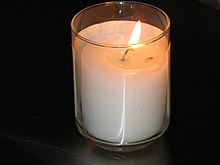
Drinking from a Yahrzeit Glass

Almost every immigrant Jewish family of the last century set their tables with identical sets of drinking glasses.  These were the three inch high, unadorned, straight-sided glasses that used to have candles in them, the diminutive holders for the ritual yarhzeit candles that were lit on the anniversary of a loved one's death, and that burned straight for 25 hours.

In the Reduce, Re-use, Recycle department, our grandmothers were masters at re-using. It never occurred to them to throw away perfectly good packaging once the product was used up, even if the product dipped into the realm of death.

Even more, back in those days, matched-set drinking glasses were given away as promotional items by gas stations, and jelly was sold in Flintstone patterned jars that could be used as drinking glasses when the jelly was all gone. Getting your drinking glasses for free and building your inventory one by one was a cultural norm.

Still and all, I found it creepy that all my friends' grandparents would drink their shot of morning  juice out of a glass that commemorated the dead. Such a casual approach to the presence of death, this gentle, constant meal-time reminder of the fleeting nature of life, was something I found, well, macabre. Perhaps on Halloween, just for fun. And maybe, maybe Rosh Hashanah. But not the rest of the year.

Years later, when it sadly came my time to burn a yahrzeit candle, the kind I found in the stores mostly came in waxed cardboard containers. I didn't have to think about what to do with them once they were empty. I threw them away.

But this year, the candles on the store shelves were once again glass. So now I have a dilemma. What do I do with this perfectly serviceable carcass of a memorial candle?

Perhaps it is my age, perhaps it is all the memories held by that flickering light, perhaps my aversion to waste, but all of a sudden, I am thinking, hm, maybe, just maybe, I should keep and use this glass?

It is not so bad, after all, to be gently reminded of the fragility of life; not so bad to have daily reminders of all the people whose features you inherited, who filled your days and taught you life's most enduring lessons; not so bad to be nudged as you embark on your day's journey to think about the flickering legacy you want to leave when your time has come.

For now, the yahrzeit glass is in the dishwasher.  I'm still not sure what I will do when I take it out.


Wednesday, October 10, 2012

Water and sukkot

If there were a new year for water, the holiday of Sukkot would be it.

It is the time of the turning of the seasons in Israel, from summer - the dry season, to winter - the wet season.

It is the time we recite plaintive prayers for rain - rain not just for our sake but for the sake of our ancestors who demonstrated their faithfulness through water, and for God's sake, who worked miracles for our ancestors through water.

Indeed the joyous holiday of Sukkot hosted the grandest extravaganza in ancient Israel's ritual repertoire: the Simchat Beit HaShoevah - the annual water pouring festival. Think Times Square on New Year's Eve, just in sandals on carved stones in the more balmy ancient Mediterranean night air.

We need such a celebration now. Something that reminds us of the preciousness of water; the ways we use it, revel in it, are soothed by it, depend upon it. We are, so they tell us, about 60% water ourselves.

But we also need to be taught about how we waste it. How our energy use consumes vast amounts of water; how fracking not only consumes but poisons millions of gallons of water; how mining by mountaintop removal should really be called mining by stream degradation and burial, affecting over 2000 miles of vital streams in the Appalachian region alone.

We need the blessings of abundant energy, yes. But we also need the blessings of abundant clean water. Yet the energy industry is exempt from the Clean Water Act both regarding valley fill and fracking processes.

We cannot continue to pit nature against itself; or put another way, to pit energy against the environment.

We can do several things.

(1) Continue to reduce our energy usage. It is good for our water and land, not just our air.

(2) Advocate to bring the energy industry under the clean water laws.

(3) Plant trees! It is amazing all the beneficial services that trees provide us, all at the same time, for a fraction of the cost of public works infrastructures. Not to mention the recreational, aesthetic  and spiritual enjoyment too. Can't say that about a water treatment plant.

(4) Make BGE accountable for all the trees it is cutting. We need to have an accounting of how many trees it took down; the environmental impact; and how and where they are going to replace those trees. (Be sure to contact BGE for your tree replacement voucher if they took a large tree down on your property. And let's advocate for a complete tree replacement policy.)

(5) Manage our own lands well. Substitute our lawns with region friendly vegetation that won't make unusual water and pesticide demands; that will hold and filter our rainwater so it stays where it falls and becomes cleansed as it percolates; and plant fruit trees to boost commitment to caring for the trees and greater neighborhood resilience due to local food production.

And for a sweet English language treatment of our traditional prayer for rain, check out this video from the Jewish Farm School.

And if you are looking for a project for your shul or class, check out Tom Horton's great idea for citizen river stewards in this week's Sun paper.

Then, tell me about what you are doing.

Thursday, October 4, 2012

Eden Inside

If ever there were an opposite of Eden it would be the Wilderness - the desert of Sinai.

Eden is a world of lush greenery, radical abundance, food for the picking, a thousand-fold return for a modicum of work, good weather, beauty all around, unity of body and spirit in a bounded place.

Wilderness is barren landscape, scratchings of life, threat of hunger and thirst, soil that will not yield even with the greatest of toil, the fearsome vulnerability of boundlessness and exposure.

Yet all is not well in Eden and all is not bleak in the wilderness. For despite all the beauty and ease of Eden, it must have been a rather boring place. All was given - there was little to do beyond a bit of gardening. There were no questions for there was no questioning; no curiosity for there was no mystery. Ease yielded dullness. Which is why it couldn't last. In an endless world of boredom and dullness, life equals death. No wonder the snake, the slithering symbol of curiosity and knowledge, finally won the day.

Beyond Eden, though, is Wilderness. It demands alertness, creativity, living on the edge of survival and celebrating every success. It means struggle and disagreement, threats and vulnerability. But it just those things that yield the greatest rewards of vibrancy, achievement, pride in work and a sense of purpose.

So, the Torah tells us, humanity traded givenness and security for discovery and striving.

Still, trading ease for imagination and safety for exposure is not the kind of bargain most of us would choose. Which is where Sukkot comes in, mediating between these two extremes.

Wouldn't it be grand if there could be a melding of Eden and Wilderness: a bungee cord of sorts that holds us and retrieves us when we venture too far; a safety net that catches us when we fly too high; a pliable, porous spiritual skin that stretches as we grow, allowing us to touch and experience the world beyond ourselves without losing our own boundaries and the integrity that defines us.

Such is the symbol and meaning of the Sukkah.


“This is to be a lasting ordinance for the generations to come;" Leviticus 23 tells us. "Celebrate it in the seventh month. Live in booths for seven days: All citizens in Israel are to live in such shelters so your descendants will know that I had the Israelites live in booths when I brought them out of Egypt. I am the Lord your God.”

Rabbinic tradition tells us that it doesn't matter what the sides of the sukkah are made of. They can be wood or stone, woven grass or the side of an elephant. For any and all of those represent the true walls, the walls of peace, the wings of God, the cloud of glory, that surround and protect us as we make our way through the wilderness of life.

The sukkah reminds us that though we cannot still be in Eden, Eden in some sense can still be with us. We cannot and will not give up the vulnerability of a vibrant, questing life, but, Sukkot wants to teach us, God's presence will wrap itself around us to escort us as we wander in the wilderness beyond. No wonder one of the main traditions of Sukkot is the mitzvah of hospitality. Included in this divine, mobile embrace are our ancestors, our tradition, our family, our friends. We do not travel through life alone.

Still, the sukkah is not impregnable. It is not bullet-proof or weather-proof or pain-proof. It is not all ease and abundance. It is, in short, not Eden. But it is the next best thing: a buffer that helps blunt the worst we must weather, a comforting cloak that envelops us as we move. And while we are asked to dwell in it only seven days, its presence travels with us wherever we go.

Tuesday, September 25, 2012

The blessing of rumble strips

Rumble strips are a fabulous invention. There you are, tooling along, minding your own business, pursuing your errand, working your way from here to there, thinking about this and that, when suddenly BRRMMMM. The strips warn you of danger. The surprise and the shaking even more than the noise bring you back on course.

You didn't realize you were dozing, or daydreaming, or distracted. You didn't realize you were weaving, threatening to make a mess of your car, yourself, your life and perhaps those of many others. And yet with just a little jostling and a nudge on the wheel, you are back on track.

How cool, how convenient, how valuable if we could install rumble strips along the paths of our lives.

Sometimes  they would help us make necessary changes: There we are, wending our way along life's path when, "BRRMMMM," we hear. " This relationship is not working for you." Or "BRRMMM, this is no longer the right job for you." Or "you are not eating right; living well; caring for self and others enough."

How can the strips tell? They know when we have lost our focus, and started veering into places we shouldn't go.

Sometimes they would keep us on the straight and narrow, reminding us that "there" is not where we ought to be; and "that" is not the thing we ought to do.

Still other times they would warn us to slow down, telling us that we are going too fast, reminding us that important things are coming up, slipping by, needing to be noticed.

The problem is, rumble strips are only put in places where others have gone before. And they don't stop us, they only warn us.

But when we go on our life's journey where no one has been before (or at least so we think), when we are blazing our own paths, there are no pre-laid rumble strips. And even when they are there, we may tend to ignore them.

That, it seems to me, is what Rosh Hashanah, and even more, Yom Kippur, are all about.

Yes, in part these holy days are to help us atone for the past. We need to do proper reckoning for our past.

But even more they are there for us to assess the present and map out our future. Are we on the right path? Are we heading in the right direction? Are we veering off or nodding off or rushing by?

The slight shaking we feel at this time of year, the sudden, forever surprising brrmmm of the shofar, are kindly reminders, saving reminders, that we are the drivers of our lives. It is we who choose our paths. It is we who often have to lay down the boundaries on the roads we travel when others have not already done so for us. It is we who need to mind the rumble strips we encounter as we barrel our merry way through life.

Listen to the rhythm of the road.

May your journey be long, safe and full of discovery.


Friday, September 14, 2012

Who Knew?

This bit of news slipped by me this summer:

Israeli soil scientist Dr. Daniel Hillel was named the 2012 World Food Prize Laureate in June for pioneering "a radically innovative way of bringing water to crops in arid and dry-land regions."

The ceremony was held at the U.S. State Department, with Secretary of State Hillary Rodham Clinton delivering the keynote address.

Amb. Kenneth Quinn, president of the World Food Prize Foundation, noted that Dr. Hillel's work was not just a scientific contribution but a social one as well.

“Confronting hunger can bring diverse people together across even the broadest political, ethnic, religious or diplomatic differences," Quinn said. “Dr. Hillel's work and motivation has been to bridge such divisions and to promote peace and understanding in the Middle East by advancing a breakthrough achievement addressing a problem that so many countries share in common: water scarcity. It is significant that Dr. Hillel’s nomination for the World Food Prize contained letters of support from individuals and organizations in Jordan, Egypt and the United Arab Emirates."

You can read the entire announcement posted back in June here.

As we enter prepare for the holiday of Sukkot (looking just a bit past the Yamim Noraim, the High Holidays), when we recite prayers and celebrate the life-giving nature of rain, and, on the world stage, sadly witness once again demonstrations of hate and violence between religions and peoples, how wonderful to know that Dr. Hillel has been recognized for contributing so much to easing hunger and bringing dignity and channels of peace to people all over the world

Wednesday, September 12, 2012

What is stuff for?

In his classic 1977 book, Space and Place, the geographer Yi-Fu Tuan writes:


“Much of a child’s combative possessiveness is not evidence of genuine attachment. It arises out of a need for assurance of his own worth and for a sense of status among his peers.”

Indeed. The question is, how much does this change as we grow up?

From shoes to cars to houses to land to corporate acquisitions ... how much of our stuff do we truly treasure for its inherent value, for the immediate services and pleasures it provides us, and how much do we cherish our possessions for the display value they offer, both to others and ourselves? 

How much do we need, in other words, to prove to ourselves that we are who we hope to be - loved, valued, worthy?

This is the season for such questions. For it is the time when we strip away all the trappings of our surroundings and possessions, all the shells and costumes that serve as our "face" to the world, and look at the naked self.

We cannot easily comfort ourselves or fool ourselves into valuing our place on this earth by counting up our possessions, especially those possessions that other people envy.

Material possessions are handy in times of stress or uncertainty or loneliness or searching. They can reinforce our sense of self, help us hold onto a vision of self when things seem to be slipping away. They can, sadly, even pretend to substitute for a sense of self. But they cannot create a sense of self. 

So once a year, as we delve into those quiet places of self we usually leave closed, we can ask what things do we need to hold our vision of self? Which things and how much?

And then, if we are honest, we can look at those answers and see what they tell us about the nature of our selves and how we are doing in our lifelong enterprise of becoming, in essence, the person we want to be.

Monday, September 3, 2012

Money for Trees

BGE is trimming and removing thousands of trees in our neighborhoods to protect their electrical wires from damage and destruction. Whatever you think about this program - it is moving forward.

One thing we can all agree on is that Baltimore needs more trees. Both the city and the county have set goals to radically increase their tree canopy (the amount of land covered by the spread of the trees). While cutting the trees may help keep the lights on, it will have devastating effects on all the good things that trees provide: absorbing and slowing our stormwater, cleaning our air, cooling our streets, securing our soil and more. And it sets back both the city's and county's tree goals.

While there is no formal program yet to replace the trees taken down, BGE will help you cover some of the costs to replace certain qualifying trees that they cut down on your property.

There are two steps you need to take:
(1) find out how many trees that were taken down qualify for the voucher program.
(2) purchase the kind of replacement trees that qualify for the voucher program.

If you had trees cut down in your yards, contact Chad Devine at Chad.S.Devine@BGE.com and ask him about the $100 per tree voucher program, and which trees of yours that BGE removed qualify for earning you a $100 voucher.

A replacment tree that qualifies for the program can grow no larger than 25 feet. It must be purchased from a licensed nursery or landscape provider and you must submit your receipt to BGE. You can find a list of qualifying trees here. While fruit trees do not appear on this list, Chad has assured us that small and dwarf fruit trees will qualify as replacement trees.

Any replacement tree is valuable. Replacement fruit trees are doubly so.

The address:
Chad Devine
BGE
White March Center
11350 Pulaski Highway
White Marsh, MD 21162

Many fruit trees qualify - especially dwarf fruit trees that allow easy picking their entire lives. Now is a great time to buy a fruit tree and plant it. And you can get a refund for their costs.
If you do buy and plant a fruit tree, please do also register it on the Baltimore Orchard Project's tree registry.

If you do not want to replace your trees, but would be willing to use your vouchers to purchase replacement trees for others to plant elsewhere in the city and county, please be in touch with me. We are considering setting up a tree exchange to maximize the number of trees planted to replace the trees taken down.

Hope to hear from you.

Happy planting!

Sunday, September 2, 2012

We and the Earth

This blog is about Judaism and the world we depend on. It is not the place for partisan politics for one very simple reason: Nature, Creation, Earth - call it what you will - is the only place we all call home.

A healthy Earth is the only thing that keeps us alive.

If the world gets sick, so do we all.

What I am about to say is not about politics. It is about the simple truth that many of us, in our continuing swoon over the impressive and well-earned swagger of technology, seem to have forgotten. Our quest for a healthy Earth is not a quixotic pursuit for some sweet but marginal damsel-in-distress out there. It is not about polar bears or spotted owls.

It is about us. It is about the essential truth that is captured in the resonance of the biblical words adam - humankind, and adamah - earth. The one is dependent on the other. To care for the Earth is to care for Humanity.

Mitt Romney nailed this mistake, this forgetting, in his acceptance speech the other night:

President Obama promised to begin to slow the rise of the oceans and to heal the planet. My promise … is to help you and your family.

That is a false distinction.

We and our families cannot thrive if oceans come crashing into our homes. Indeed the very next day, Romney went to visit families being helped by government in Louisiana, families once again displaced and disoriented by ocean waters come ashore.

We and our families cannot thrive if harvests are wiped out due to water shortages or soil degradation, or if we cannot afford to buy food, or adequately heat and cool our homes, due to increases in energy and transportation costs.

We need to remember that the health of the earth is the greatest determining factor of our physical health. And the health of the earth is the greatest determining factor of our economy's health as well.

As the economist Herman Daly reminds us, it doesn't make a difference how big our fishing fleet is, or how large our nets are if there are no more fish in the ocean. It doesn't matter how much coal there is in the ground if our water is polluted by the dumping of mountain debris, the air made rancid and the temperatures rising.

Both jobs and life need a healthy environment to thrive. We as individuals, we as families and we as a civilization need a healthy earth.

It is something we cannot forget: We and the Earth. One and the same.

Sunday, June 24, 2012

Cycles of Seven


Two weeks ago, I had the pleasure of teaching at Limmud Baltimore, one of 60 communities world-wide to sponsor "open-source" Jewish learning days in their home towns.

I spoke about the recurring cycles of seven in Judaism: one day in seven is Shabbat; one year in seven is a sabbatical; one sabbatical in seven is The Jubilee.

Stacking up all these cycles, or better, seeing them embedded one in the other, it seemed to me that these represent so much more than the work/rest or work/release lessons we most often glean from them.

Judaism is a religion that seeks to balance the messy, joyous, frustrating realities of life with a vision of achievement and perfection, of Eden, the World to Come, the realization of Tikkun Olam.

The question is how do we keep motivated, how do we keep hope alive, how do we keep laboring for that ultimate good in the face of so little progress, so much failure, such grand disillusionment?

Judaism's answer, or so it seems to me, is to give us periodic tastes of arrival, regular tastes of accomplishment, in the midst of our daily lives. We work six days a week and then arrive at, not just rest on, the seventh day. At sunset on Friday, we enter a different time and a different place. The world may look the same but it is temporarily transformed into an outpost, an embassy, a suite of time and place that alters who we are and how we behave.

One little known midrash plays on this vision. In 18th century Italy, Jewish women would light the Shabbat candles and say the following prayer: "God of Israel, may  it be Your will to radiate light, joy, happiness, honor, goodness, mercy, prosperity, blessing and peace upon those in heaven and those here below... and may you extend graciousness through the concealed light, the light of all life..."

The "concealed light", ha'or ha'ganuz, is, according to this midrash, the light of the first day of creation. On Day One, in Genesis, God created Light. Not the sun or the moon or the stars. Those came on Day Four.  But Day One saw the birth of Light, the primordial, generative light that feeds all life.

This light (unlike the solar light we are familiar with) was so powerful it lit up the universe from one end to the other. It was so powerful it would have incinerated material life should it remain loose in the world.

So, to create the world, God gathered this primordial light of perfection and tucked it away under the divine throne to be kept safe and sound for the End of Days and the World to Come.

It is, however, released once a week, when the Shabbat candles are lit. Those two flames are emissaries of this primordial light, and portals to the world of perfection they promise.

Judaism tells us that the six days, years, cycles we work are not separate from the goal we strive for. They are the path that will get us there. And lest we despair, and give in to frustration, or believe that what we do matters not, we are gifted each week (each seventh year, each Jubilee) with increasing levels of Arrival, of a taste of being there.

The cycles, then, are much more than work and rest. They are pursuit and destination, achievement and arrival. They are what drives our work and gives us a blessedly recurring, and reliable, taste of our dreams.

(More on the differences between Shabbat, Shemittah (the seventh year), and the Jubilee (the seventh seventh year) in posts to come.

Friday, June 22, 2012

What do we pack?

 An older woman told a pastor friend of mine recently that she was going blind. She seemed amazingly obliging about the news. Having given herself over to what would come, she was working on preparing herself for the change. "I guess I am going to have to memorize my favorite portions of the Bible," she told him.

"Packing," I told my friend. "She was packing up the things she would need for this move to a new place in her life." 

What a wise and gentle woman. Without fanfare, without fuss, she was taking stock of what this change would require her to leave behind, and what she could and should take along to manage it.

We all face these "moves" at various times in our lives, most of the time when we are alone. Some of these are more modest, like traveling by ourselves or giving a book report before 40 fifth-grade critics. Others are big, like surgery or taking a new job that takes us hundreds of miles from home. 

What we pack to help us live in the move is determined by what we have stored up over the years. These are different gifts than the coping skills we employ to help us get past a transition. These are, instead, what makes the essence of us: the teachings, the voices, the visions, the ever-constant sense of belonging that bury themselves deep inside, clinging to our innards and our spirit so that it becomes impossible to separate self from luggage.

And then, when we move, as eventually we all must, we must exercise the art of packing.

In between, in preparation, as we live the hours and days of our lives in the more secure places of here and now, we should be storing up the lessons and learnings, the moments and memories that pile upon us, as much as we can. I am, by nature, not a pack rat. Indeed, straightening closets, discarding things and making empty space brings me great joy.

But there, in my spiritual attic (which I seem to  enter more easily these days, prodded by a gentle tug of the attic door's dangling cord of scents and sights and sounds), it seems I can never get enough.

So I am trying harder, eager to hold fast to the visions around me: of a tiny white pine nestled improbably in a nook of a gnarled old dogwood; and the different shades of green of the tulip poplars in April and August; and our neighbors' glen on a summer's night flashing endlessly, silently, with battalions of lightning bugs charging up 100 foot trees. And a thousand more memories of loved ones' laughter, stories, lessons, and wisdom.

These - and others - are things I will store away in the attic, ready to be packed and taken with me when times get hard; when winter winds blow; and when the next step is mine to take alone.


Sunday, June 3, 2012

Blowing Up

It was about 7:00 pm Sunday when a text came through on my phone warning me about a possible thunderstorm passing through.  (Yup. I get The Weather Channel's foul weather warnings texted to me. I love it.)

Yea, sure, I thought. There was nothing but  bright blue sky all around, the end of a lovely day that was ending a lovely weekend. So I saddled up my tennis shoes, grabbed my cell phone and headed out the door.

I wanted to go out and photograph the 3 or 4 fruit trees my husband and I had seen the day before on a Shabbat walk, sans phone. We believe we found an apple tree, a chestnut tree, some berry trees, a walnut tree and another tree which we could not even take a guess at. As always, in such situations, I try to take a photograph and send it to my friend Charlie Davis, head of the Natural History Society of Maryland, a wonderful group of naturalists and friends who devote themselves to preserving and interpreting the natural history of our state, and educating the rest of us about it.

So off I went, out the door by 7:06 - in the streaming sunshine. Although, come to think of it, when I looked really hard, it did, almost imperceptibly, seem to be a bit darker than usual for that hour of the day. So, just in case, I decided to alter my route so that it would take me on a circuit that, while allowing me to walk for miles should I wish, would also never leave me further than 10 minutes away from home.

I was not outside for 5 minutes before the bulbous, bulging leading edge of an enormous dark sky appeared atop trees on the jutting ridge that formed the hill I liked to walk. "Really?" I muttered.

I then heard the rushing, rustling, vibrant sound that I always confuse: water or leaves, friend or foe. I checked the stream. It wasn't the water. I looked up at the towering trees. They weren't moving either. Yet.

It was, I realized, the trees behind them, down the other side of the rise. The wind was coming up the valley wall, pushing the sound even before it began to push the leaves. By this time, the dark clouds looked like a monster bent on consuming the sky before it.

A man and his dog came out to investigate. Yup, we determined, it looks like it is going start blowing up soon.

It was time to head back home. The fast-moving clouds had overtake me by then; they had devoured the sun and it felt like they were coming after me. The wind had caught up too, strong enough to send showers of leaves and small branches raining down to the ground. Which is where I was - and I still needed to get through the back woods to my house, beneath a bountiful but not always sturdy canopy of poplars.

A deer and I eyed each other, both knowing that we needed to find shelter soon. If it hadn't been so exciting, and if I hadn't been so close to home, I might have been frightened. It truly felt like the world was being engulfed by a darkening, drenching monster.

I got home 7:36. The rains started in earnest 7:48 or so.

It is still dark as I write; still raining, though not the thunderous, pounding rain of monsters. Just the gentle rain of a warm summer day.

I wonder if all thunderstorms feel like this and act like this and I just never paid attention.

All I know is, it was pretty awesome.


Thursday, May 31, 2012

BGE and Your Trees

It was the perfect day today - low humidity, soft sun, warm enough to soothe your muscles but cool enough to keep you outside. The birds seemed particularly cheery, or at least chirpy, today. I even managed to do a little weeding, though in my haste I interrupted two ladybugs in the midst of their intimacy. They scrambled (well, she did, he meanwhile hitchhiked, grasping her carapace for dear life) to the underside of a blade of grass to continue their tryst in greater discretion.

A wee bit later, the doorbell rang and a friendly BGE tree guy stood there, innocently enough.

"Hi. I am ... Do you have a moment to step outside and walk your yard with me. I'd like to talk to you about the trees I want to take out."

So here was this perfect day, suddenly becoming very dark. I know what these gentle BGE guys are about, and know they must be trained in the best tactics of anger-deflection and confrontation-avoidance. 

So I was somewhat prepared to go with him where I didn't want to go. Indeed, I was with him for about the first 25 words of his "Hi" speech, steeled against the reality of radical trimming that needed to be done to assuage the Maryland Public Services Commission and the public against BGE's horrific response to our too frequent and too long outages.

It is the trees' fault, we are told. Too many are too weak and too close to the wires. The solution to sketchy service: trim 'em back. Only, what my friendly neighborhood BGE tree guy was telling me (Baltimore Orchard Project me; tree planting me) was that trimming would not suffice in my case. He needed to take the trees down! Splice, dice and chew them up.

When I got over feeling like I had been punched in the stomach, I slipped on my shoes and strode the front perimeter of my yard with him.  Nine white pines and one locust needed to go, he said. Not stable. Most of the pines are over 100 feet high and top heavy (from years of BGE trimming).

Now, let's assume for a moment that I did not buy my house in part because I loved the trees; or that cutting four trees down wouldn't leave a broad, bare swath at the base of my driveway just a stone's toss away from the stream that runs on the other side of my neighbor's yard with nothing holding the soil in place. Let's even assume that most of these pines are on their last legs and would be coming down on their own willy-nilly at some inopportune time in some inconvenient way.

I had two questions for my friendly BGE guy:

1) Will they be replacing the trees?
2) And where? My property or elsewhere?

A bit of background before I offer up the answer. Baltimore County - like every other county in the Chesapeake Bay Watershed area - is under EPA mandate to come up with ways to reduce pollution (from sediment, nitrogen and phosphorous) in stormwater runoff. One major way of achieving this reduction is increasing the number and robustness of our trees.

So, on the one hand, we are going to be spending millions of dollars in our county over the next five plus years wrestling this water pollution dragon to the ground, in part hoping to utilize the presence and planting of trees to capture, hold and filter the water.

Now, along comes BGE, with the support and indeed the mandate of the state's PSC, in the midst of a rampage of not only pruning but taking down (taking out, in the words of my visitor) whole, mature trees with root systems that run deep and sure.

So, I asked, are you replacing the trees? And the answer, incredibly enough, was, "No."

"How many trees are you taking down county wide?" I ask.

"Don't know," was the answer.

"Is there somewhere on the web I can read more about this project?" (Perhaps a fuller picture would emerge through the communications office. After all, this guy is an arborist, not a policy-maker.)

"Sure, the program is called CBCERT. You can look it up."

So, I did. 'Taint there. If it is, I haven't been able to find it. There is some mention of the PSC, but the scope and reach and impact of this tree removal program is not there.

Has anyone done an environmental impact analysis of this grand scale tree removal, I am wondering. You would think that would be important.

But just as BGE didn't come around to sink their wires into the ground when FIOS came around to bury theirs ("Why not," I asked? "If the reason we have to cut the trees is because our electric wires are above ground and if they are above ground because of the expense in burying them - which is what I was told, then why, when someone else is coming around to bury thousands of miles of wires in the ground, why don't you piggy back on that?" Answer: the world just doesn't work that way.), so the PSC and, evidently our own  Dept of Environmental Protection and Sustainability have either not taken this on or have not been successful in winning a commitment of funds or action that would guarantee the replacement of every tree that is being removed.

If you are still reading this, you are indeed a dear friend.

So here is what we have to do:

1) If the BGE guys come around to chop down your trees, ask them for a voucher to help you go out and buy a replacement tree. Then go out and buy one! Only this time make sure it is a wire-friendly variety (ie, low enough to live under the wires, even if it needs to be constantly trimmed) or don't plant it near the wires.

2) Contact Vince Gardina, Director of the Dept of Environmental Protection and Sustainability, and your council members to talk to them about what efforts are being made to assure that every single tree that is taken down will be replaced somewhere appropriate in the county.  We cannot afford to lose so many trees for all sorts of reasons, not least being our stormwater management mandate.

Let me know how it goes!

Sunday, May 6, 2012

You Should Know...

Friends, I received this alert from our District 11 representatives concerning an expansion of a local gas pipeline through our neighborhoods and protected land. The Falls River Community Association has more information on their cite; and they are working on organizing local community opposition.

Check out their link as well.


May 4, 2012

Urgent Alert - Columbia Gas Proposing Construction of Major Gas Pipeline Through Owings Mills, Greenspring Valley, Falls Road Corridor, and Northern Baltimore County

Pipeline Threatens Environment, Wildlife, and Individual Homes Across Area


From Senator Bobby Zirkin, Delegates Jon Cardin, Dan Morhaim & Dana Stein


Dear Friend,

We are writing to alert you to a proposal by Columbia Gas to construct a major natural gas pipeline through many parts of our District.  The route being proposed by this Corporation may have serious impact on many of our homes, communities, and natural environments in the 11th District.  We are writing to you with serious concerns and urge you to educate yourself about this project.

A number of constituents and community organizations have raised questions about the impact of this project.  We are working to insure that everyone is as fully informed as possible and that citizens know where to raise those concerns.

The proposed pipeline by Columbia Gas would involve digging ditches across a 21 mile path, impacting over 300 acres, following a path of their current line which was built many decades ago.  Columbia is not required to follow this path.  Construction of this magnitude would impact natural environments in its path, necessitate clearing of trees and vegetation, cross streams and wetlands, and impact wildlife.  Although lobbyists from Columbia Gas assure that they will mitigate damage, we are not convinced of this.  Environmental impacts could be severe and long-term.

Further, the project will have a serious impact on property rights and individual homes.  If approved, Columbia can add an additional 25 foot easement on properties.  This means that Columbia would essentially take for their own an additional 25 feet of someone's property.  Citizens will be forced to deal with many months of heavy construction throughout our area.  Homes may be forced to deal with the loss of forest and the natural environment.  If the project is approved by FERC, citizens could be forced to remove structures such as playgrounds and decks.  Citizens may face the choice of being paid money for the removal of such structures or eminent domain.

We are not at all persuaded that this project is necessary.  Even assuming that a line is necessary, we believe that any line should be built with minimal impact on the environment and the community.  In addition, we believe that to date, the process followed by Columbia Gas has, at best, met a minimal standard of transparency.
   
Please take the time to educate yourself and your community on this issue.  Whether you are personally affected or not by the specific route, we all share in the tremendous value of our beautiful environment and community and we should be united in this effort.
   
Columbia Gas must make application through the Federal Energy Regulatory Commission (FERC), the national agency that regulates interstate energy matters.  We are working hard to understand how state and local governments, community organizations, and citizens can impact those decisions.
   
It is important to send written comments to FERC.  They may be sent to:  The Federal Energy Regulatory Commission, Attn: Kimberly D. Bose, Secretary, 888 First St. NE, Room 1A, Washington, D.C. 20426.  You can also comment on line at www.FERC.gov and follow the link to "Documents and Filings."  There is an "eFiling" link that may be followed.  In any comment, reference Docket Number PF12-6.  This is critical as comments must be filed by May 16 in order to be taken into account in the "pre-filing period."
   
There are two meetings scheduled on this issue where you may offer testimony as well as learn details.  The first is May 8 at 7:00 pm at Oregon Ridge Lodge, 13401 Beaver Dam Road, Cockeysville, MD 21030.  The second is May 9 at 7:00 pm at Youth's Benefit Elementary School Cafeteria in Fallston.
   
Because FERC is a federal agency, we recommend contacting your federal officials.  Please contact Congressman John Sarbanes (202-225-4016), Dutch Ruppersberger (202-225-3061), Elijah Cummings (202-225-4741), or Andy Harris (202-225-5311), depending on where you live.  And also contact U.S. Senators Ben Cardin (202-224-4524) and Barbara Mikulski (202-224-4654).
   
Columbia Gas fully intends on moving forward with this major new gas pipeline in our community if FERC allows them to do so.  Note that this is for gas transmission only and it will not provide any benefit to our community in any way.  Your utility bills will not go down as a result of this project at all.  Constructing the line in the heart of our area will have serious impact from Owings Mills to Greenspring Valley to the Falls Road Corridor to Cockeysville to Northern Baltimore County to Fallston.
   
As this is a federal interstate project, it is unclear what impact our efforts will have.  But we believe it is critical to try to influence this process before FERC grants approval and it is too late.


Sincerely,

Senator Bobby Zirkin
Delegate Jon Cardin
Delegate Dan Morhaim
Delegate Dana Stein

Friday, May 4, 2012

Cleaning House

What better way to cleanse your house and your spirit than by getting rid of old things - and doing it the right way!

BJEN held the Jewish community's first electronic recycling event three years ago. Since then, we have helped safely recycled literally tons - mounds and mountains! - of materials that have since become part of our culture's technological recycling stream (parallel to nature's recycling stream).

We are very proud that now, several congregations are sponsoring their own community recycling events.

This Sunday, check out Beth El's electronic recycling (E-cycling) and document shredding event.

Shredder Truck & Ecycle
Sunday, May 6
Back Parking Lot at Beth El Congregation
9:00 a.m. - 12 noon

$10 processing donation is requested.

Shabbat shalom!

Wednesday, May 2, 2012

I forgot to tell you: we had a six-foot long black snake in our kitchen the other day. Actually, it was on tax day (which seemed appropriate, some long dark arm of government reaching into our private domain).

Evidently, the snake snuck in while the door was open during a lengthy delivery of windows.

It was immediately clear that the snake, once it got its bearings, wanted no more to do with me than I wanted to do with him. So he slithered beneath the overhang of our cabinets and proceeded to slink under our sofa in the sitting room. And stayed there 'til the nice man from critter cop came with a grabber, gloves and a bag and snatched the snake, ever-so-gently, bagged it and took it out to release it.

My friend, Charlie, has since told me that the (1) the snake was not dangerous and that (2) the state is interested in such stories. Preferably with pictures.

The Natural History Society of Maryland and the MD Department of Natural Resources are jointly conducting a five-year reptile population project called MARA: The Maryland Amphibian and Reptile Atlas.

"The goal of the MARA project is to document the current distributions of Maryland’s amphibian and reptile species using a systematic and repeatable approach.... The information gained through your volunteer effort will be used to promote the conservation and protection of Maryland’s 90+ species of frogs, toads, salamanders, turtles, lizards, and snakes. Understanding the current distribution patterns of amphibians and reptiles within the state is needed to create effective conservation strategies."


So, if you bump into a snake while out walking, mowing, or hanging your laundry out to dry (just thought I'd mention this now that summer is coming), please take a photo of it and send it along to MARA at atlas@marylandnature.org.


They can even tell you what kind of snake you saw. 


Happy hunting.


Getting from Here to There

Quote of the week:


"We are a Star Wars civilization [with] Stone Age emotions, … medieval institutions… and god-like technology. And this god-like technology is dragging us forward in ways that are totally unpredictable." E. O. Wilson in an interview with Grist.org

Not a bad assessment. We know our emotions and our structures lag far behind our curiosity, imagination and scientific discoveries. 

The question is how do we - and the world - stay safe while we build the future of our dreams?

My sense: stay with the basics - 

* care for each other - remembering the legacy of the past, honoring those here today and protecting those to come tomorrow; 
* pause a moment to think things through; then talk about it with those who might agree AND those who might not agree; 
* be passionate but not impatient
* speak out boldly and often when necessary  (E.O. Wilson also asked in that interview why the youth of today weren't on the streets protesting to protect the world that their leaders and parents are consuming before their eyes? Environmentalism was a cause of social protests in the '70's. Why not now?

Add your own wisdom and spread the word.

Sunday, April 22, 2012

Earth Day 2012


Below is the talk I had the privilege of delivering today at the Maryland Presbyterian Church on Providence Road, in honor of Earth Day.

Hope you all are celebrating - the earth is, with all this wonderful rain. 

“Midrash” is the ancient rabbinic technique of taking tantalizing verses in the Bible and creatively unfolding and reshaping them, tucking them a bit here and tweaking them a bit there, until voila, a new meaning emerges that is deftly applied to the author’s rhetorical purpose.

The text this morning comes from such a midrash on Ecclesiastes  7:13.

“Consider all that God has done: Who can make straight what he has made crooked?”

The text’s meaning is clear. It proclaims: How powerful God is! No one and nothing can countermand his word. Yet, along came a rabbi of old who decided that he could tweak the verse just a touch – changing the meaning of just one word – and thus teach an important lesson. In doing so, he created the midrash that has become the anthem of the Jewish environmental movement today.

Why, this anonymous rabbi-of-old asked, would the God of goodness make something crooked, twisted, broken?

Rather, the verse must be referring at the end not to God, but to man: “Consider all that God has done: who will be able to straighten again that which he – mankind - makes crooked?” 

With this one change in mind, from “he” meaning “God”, to “he”  meaning man, the rabbi creates the following story:

"When the Holy One, blessed be He, created the first human, He took him by the hand and led him around the garden, showing him all the trees. 

God said to the human, 'See all my works, how good and beautiful they are? Know that all I have created, I created for you. But be mindful that you do not spoil and destroy My world - for if you do, there will be no one after you to set it right."

This is a stunning sixth-century rabbinic warning that teaches us that as big and magnificent and divinely-wrought as the natural world is, it is not indestructible, not immune to degradation by human hands.

The midrash teaches us that all creation, in all its detail, in all its particularity, is God’s work, glorious but vulnerable. Like a proud artist giving a tour of their studio, God took the human by the hand and showed him each and every tree and animal and stream and hill and the ways they all fit together.

And the human was told, all this is for you! All this I did for you! Remember, it is not impervious to harm, or steeled against ruin. It is the work that I love. Be sure to treat it well.

Note that the midrash notably and I would argue intentionally does not say: “All this I give to you.”  It rather says: “All this I made for you.” This world is here for us to cherish, and use, and even improve. The human is to acknowledge it, admire it, be humbled and grateful and awed by it. It is ours to live fully with, but it is not ours to possess.

As big and magnificent and important as we humans are, we need to be humble about our place in creation. We have been given great power, and great latitude in how we use that power. We need to be mindful and deliberate and discerning so that we use our knowledge, our appetites, our curiosity, and our power for good and not for evil, for growth and not destruction. 

Along with this message, it seems to me that this story is pointing to yet something a bit deeper: that in the biblical imagination, nature is not just a gift, or commodity, or necessary accessory to the good life.   It is the very currency, the language, that God uses to speak with humanity. And therefore, it is the currency and language that we should use to speak back to God.

In the Bible – if we are good and God is pleased, the rains are soft and timely and come in just the right amount. If we are good and God is pleased, the land is blessed and giving; the harvests are bountiful and filling.

If we are not good and God is not pleased, the rain is hard and damaging, or sparse or absent; the land is parched and unyielding; the harvests are meager.

Deuteronomy 11 says:

 13 If you faithfully obey the commands I am giving you today—to love the LORD your God and to serve him with all your heart and with all your soul— 14 then I will send rain on your land in its season, both autumn and spring rains, so that you may gather in your grain, new wine and olive oil. 15 I will provide grass in the fields for your cattle, and you will eat and be satisfied.

But if not, if 16 … you will be enticed to turn away and worship other gods and bow down to them. 17 Then the LORD’s anger will burn against you, and he will shut up the heavens so that it will not rain and the ground will yield no produce, and you will soon perish from the good land the LORD is giving you. 18

We  tend to dismiss these words as quaint, outdated theological beliefs of cause and affect.  After all, we moderns don’t believe as the ancients did – we know droughts and floods, extreme weather and climate change don’t come as punishment from God in response to our bad moral behavior.

Perhaps not. But it is true that our behaviors affect the natural world, that how we manage and manipulate the environment determines the abundance, availability, health and distribution of the goodness of the natural world.

It’s true that hording and wasting, taking too much and returning too little, poisoning and trashing our waters, our land and our air upsets the ebb and flow of nature and the very systems we depend on.

So, while the Bible speaks of the necessity living in good relation to God, we can extrapolate that to mean living in good relation to God’s world. That is what the midrash is teaching. Whether through theology or natural law, failure to respect the vibrancy, integrity and moral laws of nature will bring havoc to the earth and all its inhabitants. And it is we humans who will be held responsible. And, as the midrash says, there will be no one after us to set it right. And it is in the way we treat nature that our devotion to God is measured and weighed.

The midrash continues with a haunting vision:

To what might this be likened, it asks:

To a woman who is pregnant and gives birth in jail. The child is raised in jail; grows up in jail, and his mother dies in jail.  One day, the king was travelling by the jail, and as he passed by the son shouts out to him and says: Oh King: it was in this prison that I was born, and it is here that I was raised, and here I live: but I ask you, by what sin have I earned this punishment of being here? And the King answers, Because your mother gave birth to you here.”

If we destroy the world, if we create out of it a prison of destruction, we curse our children with living in that destruction. That is something we cannot do.

How do we avoid it? In the very first chapters of the Bible, we read a phrase, a formula, that helps guide us in the task of living well with God’s gift, and of avoiding the fate we dare not bring about.

In Chapter Two of Genesis, in the story of the creation of Adam, the Bible tells us that:

“The LORD God took the man he had made and put him in the Garden of Eden “to work it and care for it.” 

It is in this pairing of verbs, this yin/yang of purpose, this balance of consumer and protector; manipulator and preserver, that the vision of how humans should and must relate to the earth is revealed and measured.

L’ovdah ul’shomrah. To till and to tend; to work and protect. These are not to be seen as two separate, sequential tasks, doing one now and the other later: mountaintop removal here and preserving the Tetons there. Our agriculture, manufacturing, energy production, recycling, waste disposal all must be a piece of preserving and not just consuming. That is the message of living right in the Bible. That is the message we in the faith community must know and speak.

This, then, is the task of the faith community:

·      To live in sync with the flow and pulse and patterns of the world
·      To live humbly and joyously with God’s awesome gift
·      To advance and preserve the work of creation
·      To be witness to the truth that living our lives this way is a most blessed and purposeful way to be.
·      And to teach the lessons of the midrash to our neighbors and children, our businessmen and politicians, our farmers and bankers, and to ourselves, saying:

'See all God’s work, how good and beautiful it is? Know that all God created, he created for us. But we must be mindful that we do not spoil and destroy it - for if we do, there will be no one after us to set it right."