Tuesday, December 27, 2011

Perfection and Contentment

(Photo from potter-sculptor.com)

While the philosophers and rabbis of old lost themselves in labyrinths of logic like: "Can we have free will if there is an All-Knowing God," mothers of old (or so I imagine) struggled with the very real question: "How can I raise my child to reach for excellence but be content with their best?"

That is, how can we, how do we, hold together two sides of an irreconcilable coin: actively seeking perfection and being content with less?

How do we avoid feeling like failures, like we are living lesser lives, when we come up short? How do we not give up, slump in our chairs, be washed in despair, and set our sights lower next time so we are not so disappointed again?

This is hardly an idle question. It is one we must all grapple with throughout our lives. It is the question that determines the essence, and difference, of religious traditions, and the difference between a content life and a unsettled one.

Judaism answers in a pithy aphorism, and in the ways we are taught to live.

"Rabbi Tarfon said: You are not obligated to complete the work, but neither are you free to ignore it." (Pirkei Avot, Ethics of the Fathers, 2:21) Our task is not to achieve perfection but simply strive for it.

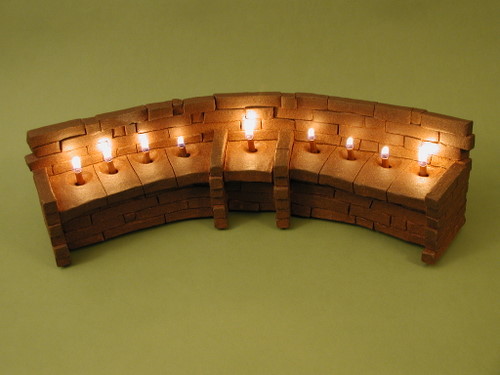
Shabbat agrees, but teaches more sweetly. We learn from the ebb and flow of Shabbat and workweek that for six days we are to work, chasing perfection, never achieving it. Yet, once a week, we get Shabbat, a taste of perfection. The candles we kindle, a midrash tells us, are sparks from the primordial light of the first day of creation. A pure light, different from the sun (which was created on the fourth day), this first light was set aside for the end of time, but it dips into this work-a-day world once a week in the form of our Shabbat candles to inspire and refresh us.

So every seven days we get a taste of perfection, a respite, a balm that celebrates our good-enough workday achievements, soothes our sagging spirits and sends us stronger back into the frail, imperfect world to keep striving for better.

Hanukkah, too, offers us a way forward. We sing of the miracle of the oil, when what was enough for one day lasted for eight. The true miracle, though, was not the oil but the faith of those who bothered to light it. The work needed to restore the Temple was beyond the task of one day. Or one precious cruse of oil. To light it would be a waste at best and a folly at worst. Yet they lit.

So too we light our Hanukkiot in the midst of darkness for eight days, even though we know that when the week is over, the darkness again follow.

We know that when we start. But we light anyway. We must. For while the lights are burning, we are buoyed. And when they go out, we start our work again.

(My thoughts on this subject were stimulated by a conversation I had with Elicia Brown who is writing an article on this subject for Jewish Women International's Jewish Woman magazine. Check out JWI, their important work and their wonderful magazine.)

Sunday, December 25, 2011

on resilience

on resilience, from The Post Carbon Reader Series. Thinking "Resilience". William Rees.

page 6: Resilient thinking recognizes that: "resource management efforts must shift from reshaping nature for the purpose of satisfying human demands to moderating human demands so that they fit within biophysical limits."

Friday, December 16, 2011

Lessons from the Darkness

We are deep into the season's darkness, hurtling toward the shortest day of the year. Our days will continue to shorten and our nights will continue to lengthen until the welcome solstice (Thursday, December 22, 2011 at 12:30 AM here in Baltimore). Then, the sun will cease its southern recession, pause and begin its northern trek again. On that day, night in Baltimore will last 14 hours, 35 minutes and 59 seconds. That is way too much darkness.

My interfaith study group has begun delving into the nature of night, as found in the Bible. We imagined that we moderns could not begin to know the full experience of night (how it could evoke awe, depth, terrors, thickness, cover, refuge) as did those who lived before the easy flip of a switch. Our experience of darkness and our fabulously easy ability to create light right here and now strips out the rawness of unrelenting darkness. Back in the day, the dark must have felt as much like a creature, a presence, as a duration of time.

So we are reading narratives of night in the Bible. We began with Genesis 1 - a good place to start.

When God began to create the heavens and the earth - the earth being unformed and void, with darkness over the surface of the deep, and a wind from God sweeping over the water - God said, "Let there be light." And there was light. (New Jewish Publication Society translation)

Or, in the creatively faithful translation of Everett Fox:

At the beginning of God's creating of the heavens and the earth, when the earth was wild and waste, darkness over the face of the Ocean, rushing-spirit of God hovering over the face of the waters - God said, Let there be light. And there was light.
It is our good fortune to have both a sailor in our study group, someone who has logged thousands of hours on the water, day and night, and a theater director. So we read and saw this text through their eyes.

The beginning of time began in water and darkness. That was the setting: darkness and water. Imagine that, our director said: all darkness, all around. You can see nothing. You know nothing about space, place, orientation. You have no sense of what "here" is. You just sense your body but don't really know what it looks like. And then you feel a whoosh.

The sailor explained to us that not seeing on the water is different from not seeing on land. One's exposure, lacking of bearings, leaves one feeling vulnerable.

You can walk in the darkness, count your footsteps, feel the rise and fall of the land, find a tree or rock to serve as a marker. There is a way to ground and orient yourself, even if only minimally. Not so in the dark at sea. You can stay put on land, know that you wake up at the same place you lay down on land. Not so at sea. (Yes, there are anchors for larger boats in shallower areas but not for all boats and not deep at sea and not here in the story.)

Even more, our sailor told us, it is not the water that is most attended to on the open sea. It is the wind. Water is water, he said. It is when it is whipped up by the wind that you notice it and must respond. The responsiveness of the sails, sense of security, ease, confidence - all are determined in some measure by the wind. A sailor is ever attentive to the wind's speed, force, direction, waxing, waning. It is the wind that will determine the quality of the trip. And at night, in the darkness, exposed and drifting, the wind can feel like the whooshing, rishrushing of God.

With this understanding, the "rushing spirit/wind of God" takes on new resonance. In the midst of the chaotic, watery mass of creation, the text is telling us, there appears a constant, flowing wind that soothes and calms and fashions the world.

Perhaps even more, we can learn from this text that when we find ourselves adrift, afraid, in the dark, at a loss, we should pause, stay still, and attend to the spirit/wind that blows over the depth. Then, perhaps, the light will come.

Thursday, December 15, 2011

Desire

(This is my column, written for the Bay Journal News Service, that appeared in the Baltimore Sun earlier this week:)


Ever since Adam and Eve took a bite of the apple, we have been haunted by Desire, that shape-shifting seducer who promises us beauty, understanding and fulfillment if only we chase after More.


On the one hand, that is a blessing. We would still be clumsy, clueless creatures huddling in caves — or naked in the Garden — without it.


Desire and appetite drive our ambition, fire our curiosity and lead us to discover in ways that complacency and fullness never can.


It is Desire that propels culture forward, urging us to explore, to dare, to persevere so we may uncover all the wisdom, comforts and delights that make life grand.


It is Desire that gives rise to the dignity of human achievement. Science, mathematics, medicine, the arts all depend on curiosity, appetite, the drive for more. It is these that have enabled us to recognize the awesome, intricate elegance of creation. What a pity if there were this grand universe and no one to gape in awe and wonder.


Should God ask us, as He asks Job in the Bible, “Can you tie cords to the Pleiades or undo the reins of Orion? Can you send an order to the clouds or dispatch the lightning on a mission?” It is Desire that would have us answer, “Not yet, but we are trying.”


On the other hand, Desire is a curse. If left unchecked and undisciplined, it will drive us to excess, consuming both our resources and our spirit, and still not make us happy.


Unchecked Desire propels us right past Enough and straight toward the never-attainable More. We believe that if we just had one more handbag, one more car, one more bathroom, one more franchise, one more road, one more mall, we would be happy. Never mind that the last time we tried that it didn’t really work. This time, it will be different.


Even more, consumer desire, we are told, fuels the economy. But the dark secret is that it does so by fanning our discontent. Unhappiness is the currency that keeps the marketplace humming. If the consumer forgets,” Jean Baudrillard said, “he will gently be reminded that he has no right to be happy.”


That is not good. Such a reckless Economy of More wreaks havoc on both the spirit and the environment, and ultimately back on the economy itself. The current world-wide crisis was not brought upon us by people buying too little but by people grasping for too much.


Once upon a time, the earth could absorb our reckless habits of consumption. No more. We are now 7 billion strong, growing at an astounding rate of 1 billion every 12 years. As the eminent Harvard biologist E. O. Wilson teaches us, humans have now become a geophysical force. Our numbers and our capacity can overwhelm global systems.


We may not [yet] possess the keys to the vaults of heaven or be able to call the wind to give birth to spring, but with our unchecked appetites we can foul the air and spoil the oceans and strip the Earth of fertile soil. We can destroy whole ecosystems, harvest the very last speck of nature’s bounty, rip the earth to shreds by desperately digging out the last crumbs of energy and metals. If we are the stewards of God’s creation, as many of our traditions say we are, presiding over global degradation and species extinction is not a good thing to have on our resume.


The solution may lie in the concept of Enoughness, in balancing the urge of Desire with the peace of satisfaction, the restlessness of curiosity with the quiet of contentment. The solution lies in knowing when and where we are full enough, and when we need more, to proceed humbly. It lies in creating systems that breathe in sync with the systems of the Earth so that discovery, creation, consumption and dissolution happen within the bounds of nature’s way.


Humans have never been good at this balance. Adam and Eve can tell you that. But we can learn to do it better than we ever have before, and today we know we must. For with all the upset caused by eating the apple, Adam and Eve had somewhere else to go. For us, there is nothing outside the Garden.

Tuesday, December 13, 2011

Cisterns or Trees

There is a wonderful teaching in the Jerusalem Talmud which reads: "Rabbi Yohanan, speaking on behalf of Rabbi Yossi, says: 'Just as they (the other rabbis) believe that civilization depends on cisterns, so I believe that civilization depends on trees.'"

The work of blending civilization and nature has always been a challenge. In this "man vs nature" tug of war, we must ask, who wins? What has precedence over what; what should yield to what?

Gray infrastructures - the built environment of houses, streets, marketplaces, and water systems are often seen as more essential than Green infrastructure - trees, wetlands, swales, hills, bees, bats and more. (Think cutting down 40-year-old trees to make way for a 3-day Grand Prix.) Nature is seen as either plentiful or wild, or otherwise able to be pushed around and manipulated and superseded by humanity's better management.

This discussion has echoes in old rabbinic texts exploring the rights of neighbors, landholders and trees.

In the case Rabbi Yohanan commented on above, the rabbis ask, how far apart must a tree on one neighbor's property be planted from a cistern (a pit dug to hold water) on an adjacent neighbor's property?

The answer was 25-50 amot, depending on the type of tree. (This way, the cistern would be reasonably safe from intruding roots.)

What if the tree and cistern are found to be too close? The rabbis answer: if the cistern was there first, the tree should be cut down, and the tree owner compensated. If the tree was there first (or if you are not certain which came first), the tree remains.

But Rabbi Yossi objects: not so. Even if the cistern came first, you do not cut the tree down.

Rabbi Yossi seems to be arguing for property rights: I can do what I want as long as it is in the domain of my property.

Okay, truth be told, I am not enamored of this position if Rabbi Yossi would also say that you can just as easily choose to chop down all the trees on your property on a whim. I am hoping that Rabbi Yosi would say even personal property rights have their limit when it comes to preserving nature.

So I am going with Rabbi Yohanan who interprets Rabbi Yossi as meaning: grey infrastructure depends on green infrastructure. Civilization, and the grey infrastructure that defines it, cannot survive without nature; nature will survive (battered and changed, perhaps, but ultimately triumphant) without civilization.

Cisterns are invaluable, after all, only so long as rain and water flow. Trees bring shade and bring water, hold the soil and protect your crops.

Good trees, good nature, make good civilization. We do need civilization to make nature usable to us, to turn grain into breads, wool into coats, stone into buildings, wood into homes, rain into captured water. And we need civilization at times to protect us from nature: wild animals, illness, the rawness of weather.

But we cannot abuse, push around, ignore or sacrifice nature and believe civilization will survive. We need to live within the tides of nature, mine the wisdom of biomimicry, yielding our forceful ways of civilization to the more efficient, elegant ways of nature. Then it will not be a question of who wins. We all do.

Tuesday, December 6, 2011

Filthy Banking

You would hardly know that in Durban, many of 194 party members of the United Nations Framework for Climate Change are meeting for the 17th COP (Conference of the Parties) to continue to explore how to save the planet from itself.

This is the group that brought us the Kyoto Protocol in 1997 which sought to limit the amount of greenhouse gases the world emits. The UNFCCC has posted videos of key presentations and links to various reports. And more are coming.

In concert with this annual event, four environmentally-concerned organizations have issued their own Bankrolling Climate Change report, which studies the coal-heavy investments of many of the world's leading banking institutions.

Truth be told, it makes only the tiniest difference if your bank says it is "green" as it saves millions of pieces of paper (and millions of dollars) through on-line banking services if it still invests billions in dirty, destructive, dislocating coal-mining practices that destroy millions of acres of trees, foul the air with coal ash, force abandonment and relocation of tens of thousands and continue to spew CO2 into the atmosphere instead of investing in the next generation of essential life-sustaining energy.

This study is chock full of frightening information, such as, if China alone continues on its present pace of increasing the mining and burning of coal, by 2030 it will be spewing out as much CO2 emissions into the atmosphere as the whole world is doing now.

The report is a call to investors like you and me around the world to hold our banks to account.

Find out if your bank is one of the main investors in continuing to promote this fatal technology. And if it is, put your money where your mouth is.

Thursday, December 1, 2011

Wealth and Worth

The Maryland Chapter of the American Jewish Congress is developing a Green and Just Celebrations Guide for the Jewish community of Baltimore. Inspired by a guide of the same name published by Jews United for Justice in Washington, DC, it will be available (fall 2012) through synagogues and on the web, designed to make events and celebrations environmentally friendly, socially responsible, affordable and fun.

This is not the first time in Jewish history that the Jewish community has tried to wrestle with excessive and indulgent celebrations. "Sumptuary Laws" (provisions that sought to control extravagant personal spending and consumption) popped up over the centuries. From Rabban Gamaliel 2000 years ago (who sought to take the financial sting out of funerals, making them simpler and more affordable for the 99%) to the Rhine community in the 13th century to the Frankfort community in the 17th century to the Italian community in the 18th century.

The quest to control excessive consumption had two goals: (1) to relieve the social pressure on individuals and families who otherwise would spend more than they could afford; and (2) to avoid the waste of communal resources.

The challenge was how to do that. How does, how should, a community measure wealth and create just expectations for appropriate levels of spending?

Clearly, the definition of "excess" varies depending on financial capacity. The poor should not compete with or emulate the rich in their celebrations. But the rich should not flagrantly flaunt and waste their riches either. How, then, to figure out the right amount of whoopie?

The Council of the Four Lands (in the area of Poland today), came up with the following rules:
A. "The leaders of the community have agreed to deal severely with excessive and wasteful spending for festive meals...It is decreed that the number of participants at a simcha (celebration) be in accordance with one's financial position."
Clear enough. The expense of a celebration increases with the number of guests, so if you limit the number of guests, you limit the expense. And, the number of guests one can invite depends upon one's wealth.

Now the question was, how to assess a person's wealth, always a sticky task. But there was one way in which people's wealth was publicly known. Through their philanthropy.
B. "One who pays two golden coins [to the community chest] can invite 15 people [to a bris]; one who pays four coins can invite 20 people; one who pays six coins can invite 25 people... And every 10 invitees must include at least one poor person." (quoted from Meir Tamari, With All Your Possessions: Jewish Ethics and Economic Life)
One's wealth was known by the amount one gave away. Having money, building great big houses and wearing expensive clothes and jewelry was not the measure by which you earned rights to large celebrations. Rather, if you had all that money, you were obliged to help the community, commensurately with what you were "worth". One's "worth," this law reminds us, is not wealth kept, but wealth given to support the needs of one's community.

The Jewish communities of old knew that wealth conferred obligation, and it was the fulfillment of this obligation which in turn conferred privilege, and helped strengthen community.

And more, in the midst of the celebration, one must remember and care for the poor.

It is a lesson we are struggling to remember today.

So perhaps we can learn more than just good consumer habits from these sumptuary laws. Perhaps we can learn good citizenship.