Monday, October 31, 2011

Return on Luck

If ever there were a time for the faith community to raise its voice about what we are doing to the environment, how we conduct business, and the mean-spirited incapacity of the government, now is the time.

In their new book, Great by Choice, Jim Collins and Morten Hansen, investigate how some of the most successful companies in the world got that way. They tested the belief that timing and luck were large players in success. Their conclusion: not luck but seizing the moment that luck provided was the key.

Everyone experiences both good luck and bad luck, they argue. The question is: do you squander it or ride it? get flattened by it or renewed by it? They call the bump after the luck: Return on Luck.

So, consider this:
  • The world-wide environment is in a most degraded state largely caused by human behavior.
  • The planet now hosts 7 billion human inhabitants, just 12 years after welcoming 6 billion, severely taxing our capacity to enable all of us to live well. (One billion people already live with food and water insecurity, meaning they often go hungry, under-nourished and with insufficient and tainted water.)
  • We are experiencing something new under the sun: never before have humans had the capacity to so alter the earth's systems imperiling all humankind.
  • We have precious little time to respond.
  • Some of the greatest environmentalists (Gus Speth, eg) and economists (Jeffrey Sachs, eg) see the problem as a spiritual failure or "a moral crisis". That is, they believe that the scientific, industrial, economic technical fixes that can be employed to turn the tide will only be taken if the human-spirit and public-will will endorse them, fight for them, demand them.
  • The most trusted institutions by far in the American landscape are the religious institutions. In a Pew 2010 poll, banks, congress, the federal government, large corporations, the news media, federal agencies, even the entertainment industry and the unions, were perceived as part of our nation's biggest problems. The faith community was seen in powerfully positive light, bested only by small businesses and technology companies.
Add to that the fact that hard news - news we would otherwise choose to dismiss, belittle or outright deny - is best received, sometimes only received, if heard from someone who is trusted.

If ever there were a time when the faith communities were in a position to speak up with a strong, moral, loving and fair voice, and guide America to the right path, now is the time.

If ever we were positioned to help American regain the civility and the environmental health that all personal, communal, economic, and national prosperity are based upon, now is the time.

And perhaps by embracing this signal challenge, the one by which our generation will be judged for all time - whether we chose to save the world's ecosystems while they are still recoverable or whether we chose to plunder them til we could plunder them no more - our stumbling congregations who are losing membership and worrying about their purpose and their own futures will be able to be rejuvenated, reclaimed and revived.

This might be a Return on Luck moment not only for the nation but our religious communities as well.

It is a moment we should not squander.

Friday, October 28, 2011

Questions

Economist Tim Jackson, in a Ted Talk, offered the following "koan" of sorts:

We are people being persuaded to spend money we don’t have
on things we don’t need
to create impressions that won’t last
on people we don’t care about
.


This is one version of the modern story of consumption that helps explain how we got in our current mess. Like all bold statements it is not entirely true. And yet, it is true enough.

The challenges we face are enormous, and the questions they raise equally so:

1) How do we resist the seduction of the marketplace, of allowing "want" to morph into "need"?

2) What is the difference between appetite and hunger? That is, how do we know when "want" becomes "need", and when not? When is "too much"?

3) Yet, if we stop buying, what happens to the economy? How do we build a robust economy, a dynamic R&D sector, and fulfillment ("enoughness") all at the same time?

4) How do we live within the planet's bounds and still set our sights on the far reaches of the universe?

5) How do we learn to read beyond impressions?

6) How do we build real community?

7) How do we, in other words, re-center ourselves and our society?

It is fine, indeed essential, to focus on resolving the particular issues that are pulling us down: the bay, peak oil, soil erosion and degradation, and more.

But the only way we will heal all these retail problems is to look wholesale, upstream, at the root cause, which, as so much in life, lies in the human spirit.

The question to ultimately ask, then, is:

How shall we choose to live so that all of us may thrive, materially and spiritually, on this glorious but finite world we share?

Sunday, October 23, 2011

The Signs of Fall

When we lived in the northern hinterlands of New Jersey (in what now seems lifetimes ago), we knew that summer had arrived when Gene, our gentle next-door neighbor, opened up his above-ground pool.

He would clean and remove the leaf-laden cover, wash off the sides, and unshock the water. (I don't even want to know the chemical composition of the water, after a decade or more of being shocked and unshocked, shocked and unshocked. Though it did save thousands of gallons of water!)

If he did this on a weekend, we all would have the pleasure of seeing fall, winter and spring peeled away, layer by layer. If on a weekday, we would come home - greeted by this long hoped-for sign of summer.

We all need these signature moments, these small acts that help us set down markers in time's indivisible trek; these signposts that signal to us - amid our demanding distractions - that we have crossed from here to there; that we are part of an folding mystery so much deeper than our daily affairs allow us to pause and note.

Now, it is true that on a wooded lot, you would think the signs of fall are obvious enough. I rake the leaves off my gravel path one morning and by the next, they are back, thicker than before.

But there are other, more telling signs, that truly herald the presence of fall.

1) The sun now enters our home through windows it missed in summer. Both because of the height of the summer sun's journey and the presence of full foliage, the front rooms of our house get only a dappling of direct sunlight from June to September. But in the fall, the sunlight comes pouring in, so much so that I cannot see the images on my computer screen.

2) The sky is bigger now. This comes with the falling foliage. We can see so much more of the sky. We can see the daily drama of sunrise and sunset played out not only in the rise and fall of the day's light, but in the changing canvas of the heavens themselves. And in dusk's reflection on the stalwart, remaining golden leaves of our poplar trees, our woods are bathed in a light almost as glorious as Jerusalem's ethereal sunsets (without the soft pinks).

3) The noise. If you strain in the summertime, with the air laden with moisture and leaves, you can just make out the hum of I-695 about a mile away. And you never hear the freight train whistle that rolls by two miles away. Not so in the fall. In the dry, crisp, naked air of fall, you can hear the trucks whizzing by, and the whistle of the hundred-car train ferrying goods from town to town.

The buffer between our home and the mad dash of civilization is peeled back every fall. Laterally, it is a reminder - which we occasionally wistfully veer toward forgetting - of the indivisibility of nature, action, and humanity.

And even more, vertically, it is a reminder that from where I stand, looking up, beneath the still-proud congregation of shedding tulip poplars, it is a straight shot up to the heavens. Nothing obscures or interrupts my connection to the grandest galaxy in the universe except the nuisance of space.

Tuesday, October 18, 2011

Green Eggs and Us


We can learn a lot from Dr. Seuss, or a local CSA, or a child's coloring book.

That is: there's a lot more variety in the world than we think.

Not all carrots are orange; not all potatoes are white; not all watermelons are red; not all bananas are yellow.

According to Plants for a Future, there are 20,000 edible plants in the world today. Yet, fewer than 20 species supply 90% of what the world eats.

It seems that in our rush to be food efficient, we have stripped the grand diversity of nature down to a narrow, pre-digested list and thus suffer the illusion of good-world sameness which leads us to question difference. I will explain.

Food limits lead to three deficits, it seems to me.

1) We are being deprived of many delightful and fascinating food sensations, experiences and nutrients. Even for those of us who keep kosher! All edible plants - in and of themselves - are kosher.

2) We are straining our soils to grow the same food over and over again, draining the land's energies and nutrients in the process. We know the path that global monocultures lead us down. Not good and potentially devastating. (Chocolate and bananas lovers, too, beware.)

3) We learn from our food. As we eat, so we think. If we need our food to be predictable and unblemished, so too, we may be teaching ourselves that other stuff in the world needs to be predictable and unblemished.

Health food establishments such as Whole Foods and Trader Joe's reject fruits and vegetables that have blemishes or are misshapen, arguing that their customers won't buy them. But there is no obvious positive correlation between appearance and taste or value. Just the opposite. We now know that selecting food or flowers for looks often sacrifices flavor (and nutrition?) in food and smell in flowers.

Even more, lots of good food gets wasted (but hopefully processed) both in the industry and in our homes if it is less than perfect looking.

Does this habit of rejecting imperfect affect how we view life altogether? Does it affect how we view "blemished" or "misshapen" people, or how open we are to opinions and beliefs that are different from our own?

As we limit and homogenize the world around us, do we also limit and homogenize our sense of what is right and proper? Are our agricultural monocultures encouraging us to build cultural monocultures (even as the internet opens up unprecedented possibilities of mixing)? Are we increasingly building fortresses around our homes, neighborhoods and nations so that the richness (contamination?) of the "other" is kept at bay?

Even more, are we increasingly seeing our neighbors who deviate from us as the "other": the Tea Party, the Occupy Wall Street, Republicans, Democrats?

There is no doubt that this country is being riven by incivility and efforts to outright delegitimize, denigrate and occasionally demonize the other. I wonder if those who are more accepting of blemished food are more open to honoring the "other"?

(photo: a dozen eggs from Kayam Farm CSA, with one green egg in it)

Sunday, October 16, 2011

The Gardens of Antwerp

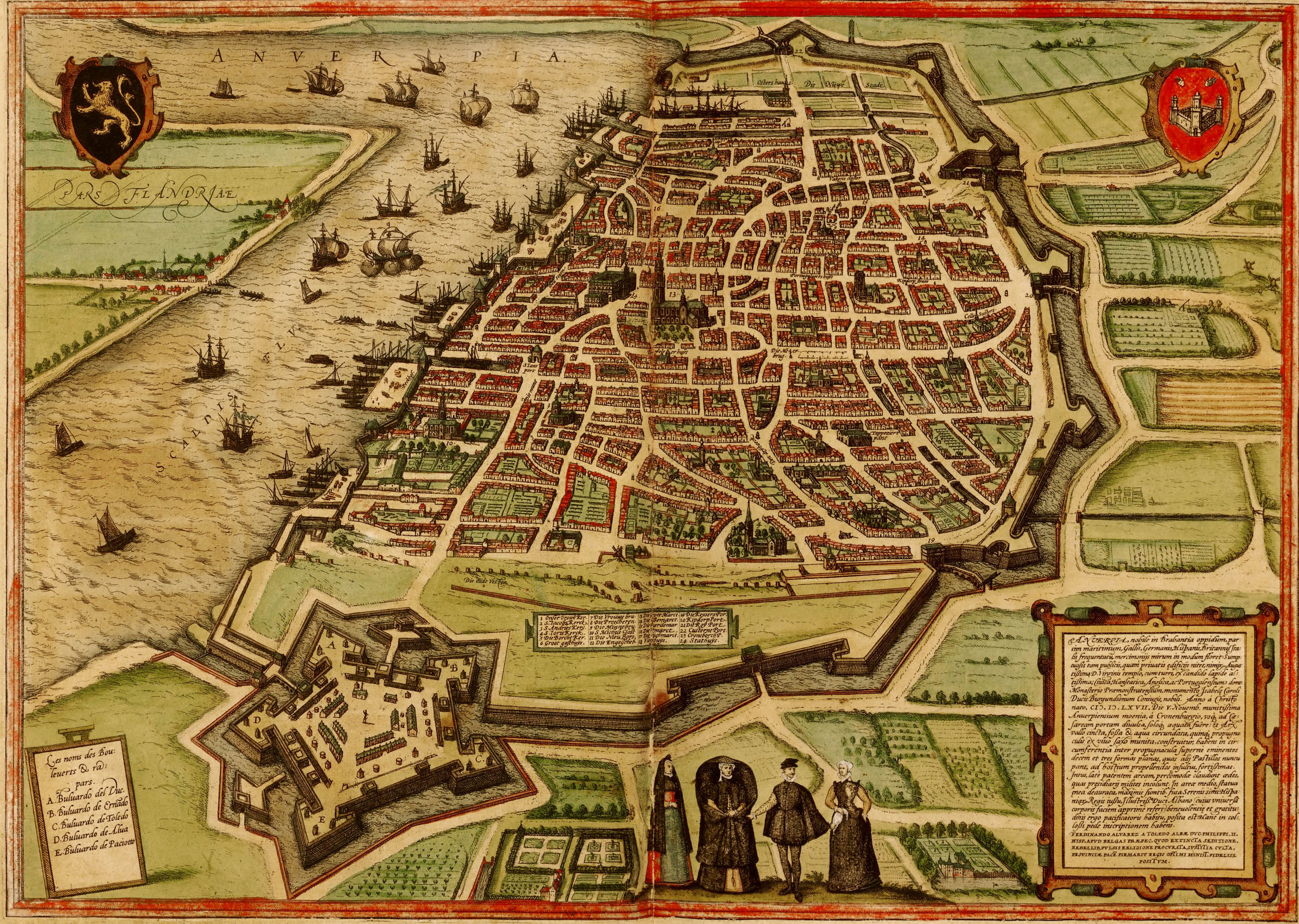
This is the city of Antwerp, circa 1572. It was one of the most cosmopolitan, creative, commercial cities of the 16th century, and home of some of the era's most impressive engravers and printers.

I found this particular map in a charming book called Imagined Corners: exploring the world's first atlas. It offers a treatment of the political, social, economic, religious, intellectual and cultural trends that gave rise to this new format - a unified, portable, bound collection of maps of the entire known world. This "atlas" (the term would not be coined til a few years later by Mercator) was called Theatrum Orbis Terrarum (Theater of the Countries of the World), created by Abraham Ortel, and it was a runaway best-seller.

(Yes, now you know, I am one of those folks who loves maps, especially old maps, and can spend hours looking at them and reading about them. A wonderful thing to do over yomtov, the holidays! One of my pet peeves is that most of our mental maps today are of political boundaries - cities, states, nations - and streets. That is because they are based on our road maps. We use maps mostly for traveling than staying, for getting from here to there rather than recording and mapping what is here. Try to find a stream or watercourse on most common maps, never mind the stream's name, and you will be sorely frustrated. Yet, we need to know the course of our rivers just as we know the turns on our streets. How different it was when land claims were marked in legal documents by, literally, "landmarks," the markings of the earth itself: the old sycamore tree or the rock with the split in it or the north bank of the local creek. How wonderful it would be to carry those maps around in our minds once more.)

But what I found most riveting about this map (at least given my present pre-occupation with urban orchards) is the way their houses were laid out. And what happened with the space in between. You can see this better on the full resolution map found here. (Click on the map to enlarge it even more.)

Throughout Antwerp, houses ringed the edges of city blocks, with open spaces occupying the land inside. Farms, orchards, (vineyards?) and perhaps even playing fields were nestled between the homes, creating a common place of food production, family gardens, as well as pastoral refuges in the middle of the city.

Commercial farms existed on either side of the city (beyond the moat on the north, east and south and along the river on the west). But the pocket farms were urban gardens, tended no doubt for the self-same reasons we tend community gardens today.

We can learn from this model. As we begin to re-imagine the design of our cities, as we begin redraw the lines between nature and home, green and built infrastructure, Antwerp of old offers us a wonderful alternative. We can build fields among buildings, farms alongside businesses, gardens nestled amid the courtyards of condos.

It sounds like a wonderful place to live.


(map from wikimedia commons)

Monday, October 3, 2011

Wangari Maathai and a billion trees

In the run-up to the New Year, a bit of news may have escaped noticed:

"Wangari Muta Maathai died on September 25 (1940–2011). She was a Nobel Peace Laureate; environmentalist; scientist; parliamentarian; founder of the Green Belt Movement; advocate for social justice, human rights, and democracy; elder; and peacemaker. She lived and worked in Nairobi, Kenya."

Her pioneering work, her unquenchable pursuit of justice, her unending optimism inspired millions around the world.

She died at a time heavy with meaning in the Jewish tradition. This week and next, during our Yamim Noraim, these Days of Awe, we celebrate the creation of the world, circle back to the freshness and promise when all was new, when both we and the world were young.

Every year, no matter the disappointments or losses or frustrations we knew, our tradition infuses us with daring, with hope, with what we can do tomorrow.

Such, too, were the native attributes of this remarkable woman. Every day a new day in this astonishingly awesome, unique and fragile world of ours.

In her memory, in your yard, at your congregation, in Israel or somewhere else around the world, plant a tree. Give the world a little more life to remember, in gratitude, one grand life.