Tuesday, December 27, 2011

Perfection and Contentment

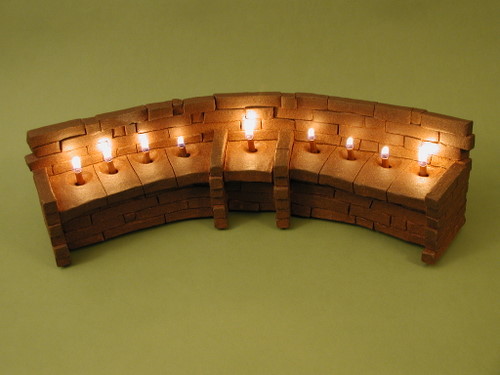
(Photo from potter-sculptor.com)

While the philosophers and rabbis of old lost themselves in labyrinths of logic like: "Can we have free will if there is an All-Knowing God," mothers of old (or so I imagine) struggled with the very real question: "How can I raise my child to reach for excellence but be content with their best?"

That is, how can we, how do we, hold together two sides of an irreconcilable coin: actively seeking perfection and being content with less?

How do we avoid feeling like failures, like we are living lesser lives, when we come up short? How do we not give up, slump in our chairs, be washed in despair, and set our sights lower next time so we are not so disappointed again?

This is hardly an idle question. It is one we must all grapple with throughout our lives. It is the question that determines the essence, and difference, of religious traditions, and the difference between a content life and a unsettled one.

Judaism answers in a pithy aphorism, and in the ways we are taught to live.

"Rabbi Tarfon said: You are not obligated to complete the work, but neither are you free to ignore it." (Pirkei Avot, Ethics of the Fathers, 2:21) Our task is not to achieve perfection but simply strive for it.

Shabbat agrees, but teaches more sweetly. We learn from the ebb and flow of Shabbat and workweek that for six days we are to work, chasing perfection, never achieving it. Yet, once a week, we get Shabbat, a taste of perfection. The candles we kindle, a midrash tells us, are sparks from the primordial light of the first day of creation. A pure light, different from the sun (which was created on the fourth day), this first light was set aside for the end of time, but it dips into this work-a-day world once a week in the form of our Shabbat candles to inspire and refresh us.

So every seven days we get a taste of perfection, a respite, a balm that celebrates our good-enough workday achievements, soothes our sagging spirits and sends us stronger back into the frail, imperfect world to keep striving for better.

Hanukkah, too, offers us a way forward. We sing of the miracle of the oil, when what was enough for one day lasted for eight. The true miracle, though, was not the oil but the faith of those who bothered to light it. The work needed to restore the Temple was beyond the task of one day. Or one precious cruse of oil. To light it would be a waste at best and a folly at worst. Yet they lit.

So too we light our Hanukkiot in the midst of darkness for eight days, even though we know that when the week is over, the darkness again follow.

We know that when we start. But we light anyway. We must. For while the lights are burning, we are buoyed. And when they go out, we start our work again.

(My thoughts on this subject were stimulated by a conversation I had with Elicia Brown who is writing an article on this subject for Jewish Women International's Jewish Woman magazine. Check out JWI, their important work and their wonderful magazine.)

Sunday, December 25, 2011

on resilience

on resilience, from The Post Carbon Reader Series. Thinking "Resilience". William Rees.

page 6: Resilient thinking recognizes that: "resource management efforts must shift from reshaping nature for the purpose of satisfying human demands to moderating human demands so that they fit within biophysical limits."

Friday, December 16, 2011

Lessons from the Darkness

We are deep into the season's darkness, hurtling toward the shortest day of the year. Our days will continue to shorten and our nights will continue to lengthen until the welcome solstice (Thursday, December 22, 2011 at 12:30 AM here in Baltimore). Then, the sun will cease its southern recession, pause and begin its northern trek again. On that day, night in Baltimore will last 14 hours, 35 minutes and 59 seconds. That is way too much darkness.

My interfaith study group has begun delving into the nature of night, as found in the Bible. We imagined that we moderns could not begin to know the full experience of night (how it could evoke awe, depth, terrors, thickness, cover, refuge) as did those who lived before the easy flip of a switch. Our experience of darkness and our fabulously easy ability to create light right here and now strips out the rawness of unrelenting darkness. Back in the day, the dark must have felt as much like a creature, a presence, as a duration of time.

So we are reading narratives of night in the Bible. We began with Genesis 1 - a good place to start.

When God began to create the heavens and the earth - the earth being unformed and void, with darkness over the surface of the deep, and a wind from God sweeping over the water - God said, "Let there be light." And there was light. (New Jewish Publication Society translation)

Or, in the creatively faithful translation of Everett Fox:

At the beginning of God's creating of the heavens and the earth, when the earth was wild and waste, darkness over the face of the Ocean, rushing-spirit of God hovering over the face of the waters - God said, Let there be light. And there was light.
It is our good fortune to have both a sailor in our study group, someone who has logged thousands of hours on the water, day and night, and a theater director. So we read and saw this text through their eyes.

The beginning of time began in water and darkness. That was the setting: darkness and water. Imagine that, our director said: all darkness, all around. You can see nothing. You know nothing about space, place, orientation. You have no sense of what "here" is. You just sense your body but don't really know what it looks like. And then you feel a whoosh.

The sailor explained to us that not seeing on the water is different from not seeing on land. One's exposure, lacking of bearings, leaves one feeling vulnerable.

You can walk in the darkness, count your footsteps, feel the rise and fall of the land, find a tree or rock to serve as a marker. There is a way to ground and orient yourself, even if only minimally. Not so in the dark at sea. You can stay put on land, know that you wake up at the same place you lay down on land. Not so at sea. (Yes, there are anchors for larger boats in shallower areas but not for all boats and not deep at sea and not here in the story.)

Even more, our sailor told us, it is not the water that is most attended to on the open sea. It is the wind. Water is water, he said. It is when it is whipped up by the wind that you notice it and must respond. The responsiveness of the sails, sense of security, ease, confidence - all are determined in some measure by the wind. A sailor is ever attentive to the wind's speed, force, direction, waxing, waning. It is the wind that will determine the quality of the trip. And at night, in the darkness, exposed and drifting, the wind can feel like the whooshing, rishrushing of God.

With this understanding, the "rushing spirit/wind of God" takes on new resonance. In the midst of the chaotic, watery mass of creation, the text is telling us, there appears a constant, flowing wind that soothes and calms and fashions the world.

Perhaps even more, we can learn from this text that when we find ourselves adrift, afraid, in the dark, at a loss, we should pause, stay still, and attend to the spirit/wind that blows over the depth. Then, perhaps, the light will come.

Thursday, December 15, 2011

Desire

(This is my column, written for the Bay Journal News Service, that appeared in the Baltimore Sun earlier this week:)


Ever since Adam and Eve took a bite of the apple, we have been haunted by Desire, that shape-shifting seducer who promises us beauty, understanding and fulfillment if only we chase after More.


On the one hand, that is a blessing. We would still be clumsy, clueless creatures huddling in caves — or naked in the Garden — without it.


Desire and appetite drive our ambition, fire our curiosity and lead us to discover in ways that complacency and fullness never can.


It is Desire that propels culture forward, urging us to explore, to dare, to persevere so we may uncover all the wisdom, comforts and delights that make life grand.


It is Desire that gives rise to the dignity of human achievement. Science, mathematics, medicine, the arts all depend on curiosity, appetite, the drive for more. It is these that have enabled us to recognize the awesome, intricate elegance of creation. What a pity if there were this grand universe and no one to gape in awe and wonder.


Should God ask us, as He asks Job in the Bible, “Can you tie cords to the Pleiades or undo the reins of Orion? Can you send an order to the clouds or dispatch the lightning on a mission?” It is Desire that would have us answer, “Not yet, but we are trying.”


On the other hand, Desire is a curse. If left unchecked and undisciplined, it will drive us to excess, consuming both our resources and our spirit, and still not make us happy.


Unchecked Desire propels us right past Enough and straight toward the never-attainable More. We believe that if we just had one more handbag, one more car, one more bathroom, one more franchise, one more road, one more mall, we would be happy. Never mind that the last time we tried that it didn’t really work. This time, it will be different.


Even more, consumer desire, we are told, fuels the economy. But the dark secret is that it does so by fanning our discontent. Unhappiness is the currency that keeps the marketplace humming. If the consumer forgets,” Jean Baudrillard said, “he will gently be reminded that he has no right to be happy.”


That is not good. Such a reckless Economy of More wreaks havoc on both the spirit and the environment, and ultimately back on the economy itself. The current world-wide crisis was not brought upon us by people buying too little but by people grasping for too much.


Once upon a time, the earth could absorb our reckless habits of consumption. No more. We are now 7 billion strong, growing at an astounding rate of 1 billion every 12 years. As the eminent Harvard biologist E. O. Wilson teaches us, humans have now become a geophysical force. Our numbers and our capacity can overwhelm global systems.


We may not [yet] possess the keys to the vaults of heaven or be able to call the wind to give birth to spring, but with our unchecked appetites we can foul the air and spoil the oceans and strip the Earth of fertile soil. We can destroy whole ecosystems, harvest the very last speck of nature’s bounty, rip the earth to shreds by desperately digging out the last crumbs of energy and metals. If we are the stewards of God’s creation, as many of our traditions say we are, presiding over global degradation and species extinction is not a good thing to have on our resume.


The solution may lie in the concept of Enoughness, in balancing the urge of Desire with the peace of satisfaction, the restlessness of curiosity with the quiet of contentment. The solution lies in knowing when and where we are full enough, and when we need more, to proceed humbly. It lies in creating systems that breathe in sync with the systems of the Earth so that discovery, creation, consumption and dissolution happen within the bounds of nature’s way.


Humans have never been good at this balance. Adam and Eve can tell you that. But we can learn to do it better than we ever have before, and today we know we must. For with all the upset caused by eating the apple, Adam and Eve had somewhere else to go. For us, there is nothing outside the Garden.

Tuesday, December 13, 2011

Cisterns or Trees

There is a wonderful teaching in the Jerusalem Talmud which reads: "Rabbi Yohanan, speaking on behalf of Rabbi Yossi, says: 'Just as they (the other rabbis) believe that civilization depends on cisterns, so I believe that civilization depends on trees.'"

The work of blending civilization and nature has always been a challenge. In this "man vs nature" tug of war, we must ask, who wins? What has precedence over what; what should yield to what?

Gray infrastructures - the built environment of houses, streets, marketplaces, and water systems are often seen as more essential than Green infrastructure - trees, wetlands, swales, hills, bees, bats and more. (Think cutting down 40-year-old trees to make way for a 3-day Grand Prix.) Nature is seen as either plentiful or wild, or otherwise able to be pushed around and manipulated and superseded by humanity's better management.

This discussion has echoes in old rabbinic texts exploring the rights of neighbors, landholders and trees.

In the case Rabbi Yohanan commented on above, the rabbis ask, how far apart must a tree on one neighbor's property be planted from a cistern (a pit dug to hold water) on an adjacent neighbor's property?

The answer was 25-50 amot, depending on the type of tree. (This way, the cistern would be reasonably safe from intruding roots.)

What if the tree and cistern are found to be too close? The rabbis answer: if the cistern was there first, the tree should be cut down, and the tree owner compensated. If the tree was there first (or if you are not certain which came first), the tree remains.

But Rabbi Yossi objects: not so. Even if the cistern came first, you do not cut the tree down.

Rabbi Yossi seems to be arguing for property rights: I can do what I want as long as it is in the domain of my property.

Okay, truth be told, I am not enamored of this position if Rabbi Yossi would also say that you can just as easily choose to chop down all the trees on your property on a whim. I am hoping that Rabbi Yosi would say even personal property rights have their limit when it comes to preserving nature.

So I am going with Rabbi Yohanan who interprets Rabbi Yossi as meaning: grey infrastructure depends on green infrastructure. Civilization, and the grey infrastructure that defines it, cannot survive without nature; nature will survive (battered and changed, perhaps, but ultimately triumphant) without civilization.

Cisterns are invaluable, after all, only so long as rain and water flow. Trees bring shade and bring water, hold the soil and protect your crops.

Good trees, good nature, make good civilization. We do need civilization to make nature usable to us, to turn grain into breads, wool into coats, stone into buildings, wood into homes, rain into captured water. And we need civilization at times to protect us from nature: wild animals, illness, the rawness of weather.

But we cannot abuse, push around, ignore or sacrifice nature and believe civilization will survive. We need to live within the tides of nature, mine the wisdom of biomimicry, yielding our forceful ways of civilization to the more efficient, elegant ways of nature. Then it will not be a question of who wins. We all do.

Tuesday, December 6, 2011

Filthy Banking

You would hardly know that in Durban, many of 194 party members of the United Nations Framework for Climate Change are meeting for the 17th COP (Conference of the Parties) to continue to explore how to save the planet from itself.

This is the group that brought us the Kyoto Protocol in 1997 which sought to limit the amount of greenhouse gases the world emits. The UNFCCC has posted videos of key presentations and links to various reports. And more are coming.

In concert with this annual event, four environmentally-concerned organizations have issued their own Bankrolling Climate Change report, which studies the coal-heavy investments of many of the world's leading banking institutions.

Truth be told, it makes only the tiniest difference if your bank says it is "green" as it saves millions of pieces of paper (and millions of dollars) through on-line banking services if it still invests billions in dirty, destructive, dislocating coal-mining practices that destroy millions of acres of trees, foul the air with coal ash, force abandonment and relocation of tens of thousands and continue to spew CO2 into the atmosphere instead of investing in the next generation of essential life-sustaining energy.

This study is chock full of frightening information, such as, if China alone continues on its present pace of increasing the mining and burning of coal, by 2030 it will be spewing out as much CO2 emissions into the atmosphere as the whole world is doing now.

The report is a call to investors like you and me around the world to hold our banks to account.

Find out if your bank is one of the main investors in continuing to promote this fatal technology. And if it is, put your money where your mouth is.

Thursday, December 1, 2011

Wealth and Worth

The Maryland Chapter of the American Jewish Congress is developing a Green and Just Celebrations Guide for the Jewish community of Baltimore. Inspired by a guide of the same name published by Jews United for Justice in Washington, DC, it will be available (fall 2012) through synagogues and on the web, designed to make events and celebrations environmentally friendly, socially responsible, affordable and fun.

This is not the first time in Jewish history that the Jewish community has tried to wrestle with excessive and indulgent celebrations. "Sumptuary Laws" (provisions that sought to control extravagant personal spending and consumption) popped up over the centuries. From Rabban Gamaliel 2000 years ago (who sought to take the financial sting out of funerals, making them simpler and more affordable for the 99%) to the Rhine community in the 13th century to the Frankfort community in the 17th century to the Italian community in the 18th century.

The quest to control excessive consumption had two goals: (1) to relieve the social pressure on individuals and families who otherwise would spend more than they could afford; and (2) to avoid the waste of communal resources.

The challenge was how to do that. How does, how should, a community measure wealth and create just expectations for appropriate levels of spending?

Clearly, the definition of "excess" varies depending on financial capacity. The poor should not compete with or emulate the rich in their celebrations. But the rich should not flagrantly flaunt and waste their riches either. How, then, to figure out the right amount of whoopie?

The Council of the Four Lands (in the area of Poland today), came up with the following rules:
A. "The leaders of the community have agreed to deal severely with excessive and wasteful spending for festive meals...It is decreed that the number of participants at a simcha (celebration) be in accordance with one's financial position."
Clear enough. The expense of a celebration increases with the number of guests, so if you limit the number of guests, you limit the expense. And, the number of guests one can invite depends upon one's wealth.

Now the question was, how to assess a person's wealth, always a sticky task. But there was one way in which people's wealth was publicly known. Through their philanthropy.
B. "One who pays two golden coins [to the community chest] can invite 15 people [to a bris]; one who pays four coins can invite 20 people; one who pays six coins can invite 25 people... And every 10 invitees must include at least one poor person." (quoted from Meir Tamari, With All Your Possessions: Jewish Ethics and Economic Life)
One's wealth was known by the amount one gave away. Having money, building great big houses and wearing expensive clothes and jewelry was not the measure by which you earned rights to large celebrations. Rather, if you had all that money, you were obliged to help the community, commensurately with what you were "worth". One's "worth," this law reminds us, is not wealth kept, but wealth given to support the needs of one's community.

The Jewish communities of old knew that wealth conferred obligation, and it was the fulfillment of this obligation which in turn conferred privilege, and helped strengthen community.

And more, in the midst of the celebration, one must remember and care for the poor.

It is a lesson we are struggling to remember today.

So perhaps we can learn more than just good consumer habits from these sumptuary laws. Perhaps we can learn good citizenship.

Sunday, November 20, 2011

Erev Thanksgiving

I love Thanksgiving, perhaps because it is so different from Judaism's standard, classical, biblical holidays.

All our pilgrimage holidays, for example, happen away from home, toward home, longing for home. They teach us how to create a sense of place, of pride, of belonging in the midst of wandering and dislocation. They teach us how to be centered in mobility; how to weave stories into platforms of place; how to celebrate "here" when that is all we have. What they don't speak of, given our long history of exile and exclusion, is the celebration of home. Understandably.

Passover is about leaving a home of horrors, shedding a past and journeying to a better tomorrow while in the midst of a volatile, meandering road to Home.

Sukkot is about accepting the security of in-betweenness. Neither in Egypt nor Israel, at home or on the road, we nonetheless are bidden to set up a hut to serve as our place of surety in this most unsure world. (Oddly, even the most misanthropic among us turns into a gracious host this holiday, for the liturgy recited before each dinner has us invite our ancestors, among others who might be present, as our honored guests.)

Shavuot, in the Bible, was the holiday marking the homecoming of Israel, yet somewhere in the presence of the long years of exile, it morphed into a celebration of Covenant instead, marking the law-giving in the wilderness of Sinai.

The High Holidays, too, are moments of spirit, not place. Purim and Hanukkah are about survival through wit and force.

We are ready, though, especially 63 years after the establishment of the State of Israel, to have a day that celebrates home. Yes, of course, we have the weekly Shabbat, a day of renewal and family, when the world shrinks down to habitable size and home looms large in the celebration. But perhaps because it comes every week, it does not have the lustre or homebound command of a once-a-year celebration like Thanksgiving.

Like many ethnic Americans, my family has added our particular, Jewish twist: we celebrate the night before, erev Thanksgiving. Everyone comes home Wednesday and that evening we have a boisterous brouhaha dinner with four generations, and a singularly unique combination of guests.

The centerpiece is a sculpted Tofurkey (yup, marinaded tofu molded into a turkey shape) but the real fun is being all together once again.

Thanksgiving is our one shared non-denominational American home holiday. We are not expected to fly to Cancun or the Bahamas on Thanksgiving. Airline commercials are not luring us to exotic places. This holiday's travel is not about adventure but about getting home.

The backlash about Black Friday creep - with stores opening at midnight or even 9:00 pm on Thanksgiving Thursday - reveals that many Americans believe home is where people ought to be and America's commerce can rest for one shared day.

For me, I love the festive, food-filled, flush of family. And then it only hurts a little when they are off on Thursday to their "other" family and friends.


(written beside the warming oven, in between batches of my Bubbe Ema - grandmother's - cookies prepared for the holiday)

Thursday, November 17, 2011

The shared nature of nature

In the mid-19th century, Calvert Vaux created the iconic images of the American urban landscape, including the grounds at the White House, the Smithsonian Institute and (with his newly hired young recruit, Frederick Law Olmsted) Central Park. Though Vaux started in landscape design, he later moved into designing buildings and homes that would occupy these landscapes.


A populist of sorts, he believed that access to natural beauty was a right shared by all. And that natural beauty should not be marred by ugly architecture or blocked by aggressive private ownership.


In his classic book entitled Villas and cottages: a series of designs prepared for execution in the US, 1857, Vaux makes available to the general public (at least those of a certain means) drawings for what he believes are attractive houses that can appropriately grace various natural settings and landscapes. (He believed, no doubt, that the house should be made to suit the setting and not the setting manhandled to suit the house.)


In this book, he quotes N P Willis of Idlewild, a defender of the public's access to the grandeur of nature and the limits of private ownership of public goods:

To fence out a genial eye from any corner of the earth which nature has lovingly touched with her pencil, which never repeats itself – to shut up a glen or a waterfall for one man’s exclusive knowing or enjoying – to lock up trees and glades, shady paths and haunts among rivulets, would be an embezzlement by one man of God’s gift to all. A capitalist might as well curtain off a star, or have the monopoly of an hour. Doors may lock, but outdoors is a freehold to feet and eyes. (p. 250)


One wonders what Willis and Vaux would say about how we can restore the blessings and shed
the excesses of capitalism today.

Monday, November 14, 2011

Do something about fracking

I recently purchased and viewed Gasland. It is a documentary exploring the hazards that come in the wake of hydraulic fracturing (aka, fracking) to loose natural gas from pockets within shale formations around the country.

One of those formations is Marcellus Shale. It covers nine states, including most of West Virginia, half of Ohio and Pennsylvania, large chunks of New York, Kentucky, Tennessee and just nipping the very western tips of Maryland and Virginia and northern Alabama. It is huge, the biggest shale region in the United States.

And it is in the cross-hairs of the big gas companies.

The problem is that extracting this gas through fracking causes alarming and irreparable destruction to the land, water, air, animals, land values, crops and, of course, people. Oh, and it might be the cause of earthquakes that are beginning to damage dams and upset other fragile natural and built infrastructures.

Exactly what damage and how much damage it does, we do not know, in large measure because, courtesy of then-V.P. Dick Cheney, fracking was made exempt from the Safe Drinking Water Act, the Clean Water Act, the Clean Air Act, the Superfund Act, the Resource Conversation and Recovery Act (hazardous waste act), and the Environmental Policy Act. Which not only means the drilling companies needn't comply with these protections but that no one has the authority to monitor them.

We do not know what, exactly, the gas companies are pumping into the earth to release the pockets of natural gas or how such drilling is affecting the environment and the lives around the thousands and thousands of wells. But we do know this:
  • Drinking water and ground water in areas where fracking is taking place are becoming contaminated. (The EPA recently reported that fracking contaminants were found in a Wyoming aquifer.)
  • 80,000 pounds of chemicals, most of which are toxic, are injected into each well under high pressure and remain in the ground migrating who-knows-where
  • Poisonous gases are emitted into the air through the fracking process
  • Millions of gallons of water are used to flush out the gas
  • Thousands of miles of roads with only one short-lived destination and one purpose have to be built to get the water, chemicals, building materials, people, etc to and from the well pad sites.
  • Land values are declining where fracking is occurring.
  • Banks are beginning to disallow their mortgagees from signing on with gas companies for fear that it will compromise the resale value of the house.
Perhaps not everything awful that is being said about fracking is true. But we don't know because the industry has drawn a shroud of secrecy around its operations. Two things I believe are true:
  • when big business hides behind the skirts of non-disclosure, claims exemption from the major environmental laws that have been on the books since the days of Richard Nixon, and demands that the people it leases land from must sign non-disclosure (gagging) clauses, something is very wrong.
  • if our enemies were threatening or compromising our water supply and destroying our ecosystems the way Big Gas is, we would call them terrorists.
We can do something. The Frac Act (to repeal exemption and require disclosure) was introduced in both the House and the Senate. HR 2766 and S1215. (OpenCongress is a great way to find out what is going on in Congress and tracking bills of interest.)

Senator Cardin and Congressman Sarbanes are both co-sponsors of these bills. Check on the status of your representatives. If they are co-sponsoring or supporting these bills, thank them. If they are not, tell them why they should.

To become even more involved, check out and consider joining any of the anti-fracking efforts in our region, including jewsagainsthydrofracking on Facebook.

This is that scary and that important.

Monday, November 7, 2011

Fall

The season of the long nights has returned, when the days seem to run out of steam before we do. The sun is up for only 10+ hours now. That is five hours less than the high at the summer solstice. We are losing light at an average of 2 minutes a day.

As if that isn't enough, the sun once again sets one stolen-hour earlier. The hands of our clocks had stealthily snatched the light from the morning and tacked it onto the evening. The perfect pinch, though we get caught every year. It was time to give it back.

Still, the time-change hardly changes anything. We moderns, addicted to the drug of artificial light, set our days by GMT.

And yet, the older I get, the more I feel the flow of nature's time. I am becoming like the birds: drape the cloth of darkness over my cage and I am ready to quiet down, settle in, cozy up on the couch with a cup of tea and call it a day.

Night is not just a dark version of daylight, and it cannot fully be chased away with glowing globes. Folks with Seasonal Affective Disorder have to fight to maintain their summer-level perkiness in this abundance of darkness. Throughout human history, time has been a character, an agent, a place, an opportunity, a call, a fear.

It is the messenger of love and a multiplier of loneliness, a midwife to birth and death, to feasting and celebration, to sorrow and loss. It had its own demons - Lilith being one, that seducer of men and snatcher of babies.

In the Bible, the Tanakh, it is where dreams appear and lovers tryst: where Jacob met the angel and Ruth met Boaz.

I spent this season's first long night preparing the nest, cooking, laying in stocks for the winter: applesauce from a bushel of apples, an armful of calzone for a month of Shabbat meals, a batchful of cookies (hint: don't get creative and tamper with a generation's-old family recipe).

I washed the floor and did our laundry listening to earth-songs on Pandora.

And now it is morning - with fall's sun blazing fully in the big sky, no longer fighting with the summer foliage.

Yesterday, sitting in silence at the Gunpowder Friends Meeting and seeing the wind blow up and shuffle all the leaves, one member of the service was moved to say: I am thankful for eyes that can see this shower of gold outside our window.

Small moments of grand pleasure. We need them more than ever.


(Photo image: Flagstaff Dark Sky - what our ancestors saw)

Monday, October 31, 2011

Return on Luck

If ever there were a time for the faith community to raise its voice about what we are doing to the environment, how we conduct business, and the mean-spirited incapacity of the government, now is the time.

In their new book, Great by Choice, Jim Collins and Morten Hansen, investigate how some of the most successful companies in the world got that way. They tested the belief that timing and luck were large players in success. Their conclusion: not luck but seizing the moment that luck provided was the key.

Everyone experiences both good luck and bad luck, they argue. The question is: do you squander it or ride it? get flattened by it or renewed by it? They call the bump after the luck: Return on Luck.

So, consider this:
  • The world-wide environment is in a most degraded state largely caused by human behavior.
  • The planet now hosts 7 billion human inhabitants, just 12 years after welcoming 6 billion, severely taxing our capacity to enable all of us to live well. (One billion people already live with food and water insecurity, meaning they often go hungry, under-nourished and with insufficient and tainted water.)
  • We are experiencing something new under the sun: never before have humans had the capacity to so alter the earth's systems imperiling all humankind.
  • We have precious little time to respond.
  • Some of the greatest environmentalists (Gus Speth, eg) and economists (Jeffrey Sachs, eg) see the problem as a spiritual failure or "a moral crisis". That is, they believe that the scientific, industrial, economic technical fixes that can be employed to turn the tide will only be taken if the human-spirit and public-will will endorse them, fight for them, demand them.
  • The most trusted institutions by far in the American landscape are the religious institutions. In a Pew 2010 poll, banks, congress, the federal government, large corporations, the news media, federal agencies, even the entertainment industry and the unions, were perceived as part of our nation's biggest problems. The faith community was seen in powerfully positive light, bested only by small businesses and technology companies.
Add to that the fact that hard news - news we would otherwise choose to dismiss, belittle or outright deny - is best received, sometimes only received, if heard from someone who is trusted.

If ever there were a time when the faith communities were in a position to speak up with a strong, moral, loving and fair voice, and guide America to the right path, now is the time.

If ever we were positioned to help American regain the civility and the environmental health that all personal, communal, economic, and national prosperity are based upon, now is the time.

And perhaps by embracing this signal challenge, the one by which our generation will be judged for all time - whether we chose to save the world's ecosystems while they are still recoverable or whether we chose to plunder them til we could plunder them no more - our stumbling congregations who are losing membership and worrying about their purpose and their own futures will be able to be rejuvenated, reclaimed and revived.

This might be a Return on Luck moment not only for the nation but our religious communities as well.

It is a moment we should not squander.

Friday, October 28, 2011

Questions

Economist Tim Jackson, in a Ted Talk, offered the following "koan" of sorts:

We are people being persuaded to spend money we don’t have
on things we don’t need
to create impressions that won’t last
on people we don’t care about
.


This is one version of the modern story of consumption that helps explain how we got in our current mess. Like all bold statements it is not entirely true. And yet, it is true enough.

The challenges we face are enormous, and the questions they raise equally so:

1) How do we resist the seduction of the marketplace, of allowing "want" to morph into "need"?

2) What is the difference between appetite and hunger? That is, how do we know when "want" becomes "need", and when not? When is "too much"?

3) Yet, if we stop buying, what happens to the economy? How do we build a robust economy, a dynamic R&D sector, and fulfillment ("enoughness") all at the same time?

4) How do we live within the planet's bounds and still set our sights on the far reaches of the universe?

5) How do we learn to read beyond impressions?

6) How do we build real community?

7) How do we, in other words, re-center ourselves and our society?

It is fine, indeed essential, to focus on resolving the particular issues that are pulling us down: the bay, peak oil, soil erosion and degradation, and more.

But the only way we will heal all these retail problems is to look wholesale, upstream, at the root cause, which, as so much in life, lies in the human spirit.

The question to ultimately ask, then, is:

How shall we choose to live so that all of us may thrive, materially and spiritually, on this glorious but finite world we share?

Sunday, October 23, 2011

The Signs of Fall

When we lived in the northern hinterlands of New Jersey (in what now seems lifetimes ago), we knew that summer had arrived when Gene, our gentle next-door neighbor, opened up his above-ground pool.

He would clean and remove the leaf-laden cover, wash off the sides, and unshock the water. (I don't even want to know the chemical composition of the water, after a decade or more of being shocked and unshocked, shocked and unshocked. Though it did save thousands of gallons of water!)

If he did this on a weekend, we all would have the pleasure of seeing fall, winter and spring peeled away, layer by layer. If on a weekday, we would come home - greeted by this long hoped-for sign of summer.

We all need these signature moments, these small acts that help us set down markers in time's indivisible trek; these signposts that signal to us - amid our demanding distractions - that we have crossed from here to there; that we are part of an folding mystery so much deeper than our daily affairs allow us to pause and note.

Now, it is true that on a wooded lot, you would think the signs of fall are obvious enough. I rake the leaves off my gravel path one morning and by the next, they are back, thicker than before.

But there are other, more telling signs, that truly herald the presence of fall.

1) The sun now enters our home through windows it missed in summer. Both because of the height of the summer sun's journey and the presence of full foliage, the front rooms of our house get only a dappling of direct sunlight from June to September. But in the fall, the sunlight comes pouring in, so much so that I cannot see the images on my computer screen.

2) The sky is bigger now. This comes with the falling foliage. We can see so much more of the sky. We can see the daily drama of sunrise and sunset played out not only in the rise and fall of the day's light, but in the changing canvas of the heavens themselves. And in dusk's reflection on the stalwart, remaining golden leaves of our poplar trees, our woods are bathed in a light almost as glorious as Jerusalem's ethereal sunsets (without the soft pinks).

3) The noise. If you strain in the summertime, with the air laden with moisture and leaves, you can just make out the hum of I-695 about a mile away. And you never hear the freight train whistle that rolls by two miles away. Not so in the fall. In the dry, crisp, naked air of fall, you can hear the trucks whizzing by, and the whistle of the hundred-car train ferrying goods from town to town.

The buffer between our home and the mad dash of civilization is peeled back every fall. Laterally, it is a reminder - which we occasionally wistfully veer toward forgetting - of the indivisibility of nature, action, and humanity.

And even more, vertically, it is a reminder that from where I stand, looking up, beneath the still-proud congregation of shedding tulip poplars, it is a straight shot up to the heavens. Nothing obscures or interrupts my connection to the grandest galaxy in the universe except the nuisance of space.

Tuesday, October 18, 2011

Green Eggs and Us


We can learn a lot from Dr. Seuss, or a local CSA, or a child's coloring book.

That is: there's a lot more variety in the world than we think.

Not all carrots are orange; not all potatoes are white; not all watermelons are red; not all bananas are yellow.

According to Plants for a Future, there are 20,000 edible plants in the world today. Yet, fewer than 20 species supply 90% of what the world eats.

It seems that in our rush to be food efficient, we have stripped the grand diversity of nature down to a narrow, pre-digested list and thus suffer the illusion of good-world sameness which leads us to question difference. I will explain.

Food limits lead to three deficits, it seems to me.

1) We are being deprived of many delightful and fascinating food sensations, experiences and nutrients. Even for those of us who keep kosher! All edible plants - in and of themselves - are kosher.

2) We are straining our soils to grow the same food over and over again, draining the land's energies and nutrients in the process. We know the path that global monocultures lead us down. Not good and potentially devastating. (Chocolate and bananas lovers, too, beware.)

3) We learn from our food. As we eat, so we think. If we need our food to be predictable and unblemished, so too, we may be teaching ourselves that other stuff in the world needs to be predictable and unblemished.

Health food establishments such as Whole Foods and Trader Joe's reject fruits and vegetables that have blemishes or are misshapen, arguing that their customers won't buy them. But there is no obvious positive correlation between appearance and taste or value. Just the opposite. We now know that selecting food or flowers for looks often sacrifices flavor (and nutrition?) in food and smell in flowers.

Even more, lots of good food gets wasted (but hopefully processed) both in the industry and in our homes if it is less than perfect looking.

Does this habit of rejecting imperfect affect how we view life altogether? Does it affect how we view "blemished" or "misshapen" people, or how open we are to opinions and beliefs that are different from our own?

As we limit and homogenize the world around us, do we also limit and homogenize our sense of what is right and proper? Are our agricultural monocultures encouraging us to build cultural monocultures (even as the internet opens up unprecedented possibilities of mixing)? Are we increasingly building fortresses around our homes, neighborhoods and nations so that the richness (contamination?) of the "other" is kept at bay?

Even more, are we increasingly seeing our neighbors who deviate from us as the "other": the Tea Party, the Occupy Wall Street, Republicans, Democrats?

There is no doubt that this country is being riven by incivility and efforts to outright delegitimize, denigrate and occasionally demonize the other. I wonder if those who are more accepting of blemished food are more open to honoring the "other"?

(photo: a dozen eggs from Kayam Farm CSA, with one green egg in it)

Sunday, October 16, 2011

The Gardens of Antwerp

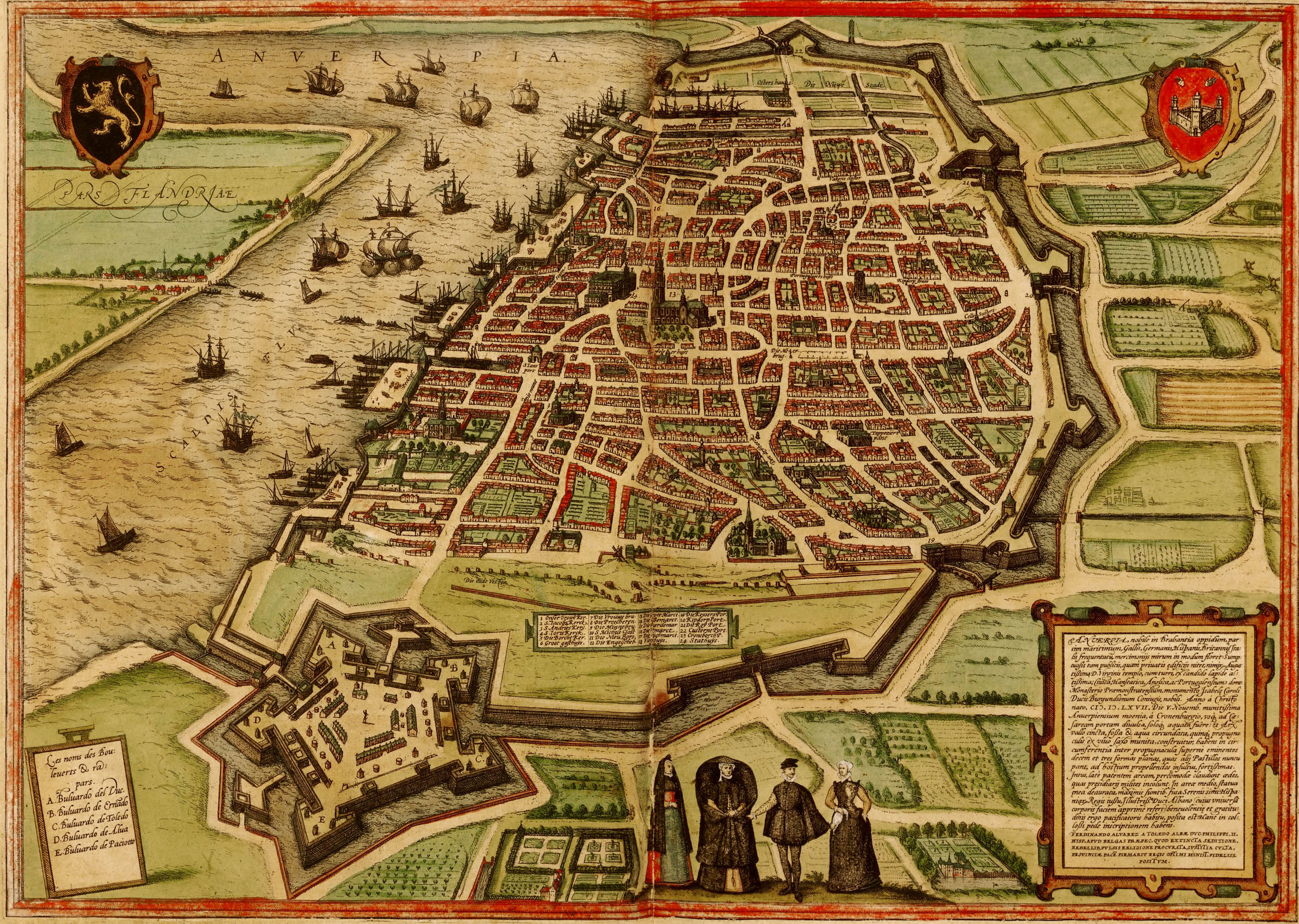
This is the city of Antwerp, circa 1572. It was one of the most cosmopolitan, creative, commercial cities of the 16th century, and home of some of the era's most impressive engravers and printers.

I found this particular map in a charming book called Imagined Corners: exploring the world's first atlas. It offers a treatment of the political, social, economic, religious, intellectual and cultural trends that gave rise to this new format - a unified, portable, bound collection of maps of the entire known world. This "atlas" (the term would not be coined til a few years later by Mercator) was called Theatrum Orbis Terrarum (Theater of the Countries of the World), created by Abraham Ortel, and it was a runaway best-seller.

(Yes, now you know, I am one of those folks who loves maps, especially old maps, and can spend hours looking at them and reading about them. A wonderful thing to do over yomtov, the holidays! One of my pet peeves is that most of our mental maps today are of political boundaries - cities, states, nations - and streets. That is because they are based on our road maps. We use maps mostly for traveling than staying, for getting from here to there rather than recording and mapping what is here. Try to find a stream or watercourse on most common maps, never mind the stream's name, and you will be sorely frustrated. Yet, we need to know the course of our rivers just as we know the turns on our streets. How different it was when land claims were marked in legal documents by, literally, "landmarks," the markings of the earth itself: the old sycamore tree or the rock with the split in it or the north bank of the local creek. How wonderful it would be to carry those maps around in our minds once more.)

But what I found most riveting about this map (at least given my present pre-occupation with urban orchards) is the way their houses were laid out. And what happened with the space in between. You can see this better on the full resolution map found here. (Click on the map to enlarge it even more.)

Throughout Antwerp, houses ringed the edges of city blocks, with open spaces occupying the land inside. Farms, orchards, (vineyards?) and perhaps even playing fields were nestled between the homes, creating a common place of food production, family gardens, as well as pastoral refuges in the middle of the city.

Commercial farms existed on either side of the city (beyond the moat on the north, east and south and along the river on the west). But the pocket farms were urban gardens, tended no doubt for the self-same reasons we tend community gardens today.

We can learn from this model. As we begin to re-imagine the design of our cities, as we begin redraw the lines between nature and home, green and built infrastructure, Antwerp of old offers us a wonderful alternative. We can build fields among buildings, farms alongside businesses, gardens nestled amid the courtyards of condos.

It sounds like a wonderful place to live.


(map from wikimedia commons)

Monday, October 3, 2011

Wangari Maathai and a billion trees

In the run-up to the New Year, a bit of news may have escaped noticed:

"Wangari Muta Maathai died on September 25 (1940–2011). She was a Nobel Peace Laureate; environmentalist; scientist; parliamentarian; founder of the Green Belt Movement; advocate for social justice, human rights, and democracy; elder; and peacemaker. She lived and worked in Nairobi, Kenya."

Her pioneering work, her unquenchable pursuit of justice, her unending optimism inspired millions around the world.

She died at a time heavy with meaning in the Jewish tradition. This week and next, during our Yamim Noraim, these Days of Awe, we celebrate the creation of the world, circle back to the freshness and promise when all was new, when both we and the world were young.

Every year, no matter the disappointments or losses or frustrations we knew, our tradition infuses us with daring, with hope, with what we can do tomorrow.

Such, too, were the native attributes of this remarkable woman. Every day a new day in this astonishingly awesome, unique and fragile world of ours.

In her memory, in your yard, at your congregation, in Israel or somewhere else around the world, plant a tree. Give the world a little more life to remember, in gratitude, one grand life.

Tuesday, September 27, 2011

Not turtles all the way down?

When the rabbis-of-old mused about the nature of the universe, their telescope was the Tanakh (the Bible), their philosophical society the pathways of Yavneh and Babylon.

Without advanced technology, with no peering devices beyond their own eyes, they used the latest - which is to say the earliest - source of knowledge they had, the texts of their tradition.

They asked: "On what does the earth rest? How does it stay up, stay put, stay stable? What supports it?" (Even framing the question was a leap of faith, what with the physics of globes and planets and space and gravity being such a grand mystery. Which it remains today, even with all we know.) For answers they turned to the words in the Bible.

"The world rests on its pillars," they answered, "for it says: 'God shakes the earth from her place till her pillars tremble.'" (Job 9:6)

But if so, the more curious wondered, what do the pillars rest on? "Upon the waters," they replied, "for it says: 'He spread forth the earth upon the waters.'" (Psalm 136:6)

And what do the waters rest on? "The mountains, for it says: 'The waters stood above the mountains.'"(Psalm 104:6)

And the mountains? "On the wind, for it says: 'For, lo, He formed the mountains and created the wind [which supports the mountains] . (Amos 4:13)

The wind in turn, rests upon the storm, for it says: "The storm gives the wind its substance." (Psalm 148:8)

The storm, in turn, rests upon the arm of the Holy One, blessed be He, for it says: "And undergirding [all creation] are God's everlasting arms." (Deuteronomy 33:27)

Finally, Rock Bottom (tzur olamim); a place that requires no other place; a support that requires no other support.

Ever curious, and eager to be more precise, the rabbis circle back to the beginning of this cascade of speculations, and wonder just how many pillars, in reality, held up the world? Some said twelve, one for each tribe. Others said seven, as in Proverbs 9.

But these answers did not satisfy R. Eleazar b. Shammua. He sought not the physical, but the metaphysical truth of existence. Material integrity allows the world to exist, he conceded. But it is spiritual integrity that enables it to thrive.

So, he asks, what is the spiritual foundation of the world? He answers, "The world rests on one pillar, and its name is ‘Righteousness’, for it is said: ‘The righteous form the foundation of the world.'" (Proverbs 10:25)

Rosh Hashanah is when we celebrate the birthday of the world. It is an appropriate time to speculate on what holds it up and what keeps it going.

It is humbling and exalting to imagine that the righteous tasks we do, both large and small, day in and day out, form the foundation that keeps this world going. But be certain that they are, for in truth, nothing else can.

Shana tova. Have a happy, healthy, peaceful and prosperous new year.

And may it be filled to overflowing with righteous tasks.

(Based on the Talmud, Hagigah 12b)

Wednesday, September 21, 2011

Nature's answers

Janine Benyus is widely known for her pioneering work promoting biomimicry, that is, answering our technological needs by mimicking nature's ways.

Nowadays, industry makes things by "heating, beating and treating." Which may get the job done but often leaves destructive residues, gobbles up enormous amounts of financial and energy resources and only gets us half-way there.

Nature, on the other hand, has been field-testing the best ways to build things, dissolve things, grow things, arrest growth, and altogether thrive in the most efficient and enduring ways.

If we can conduct our industry in ways that are cheaper, enduring and better, why wouldn't we?
That is the promise of biomimicry.

As Benyus says, "Learning about the natural world is one thing, learning from the natural world... that's the switch."

Brew a cup of tea, sit on a comfy chair and take 20 minutes to watch her TED talk. It will inspire you, and give you hope!

Friday, September 16, 2011

Aftermath of Irene and Lee

While we are basking in lovely fall weather, the Bay is taking a beating. Courtesy of our recent storms.

Click here to see the total matter suspended in the Chesapeake and Delaware Bays (before and after the storm comparisons).

And here to see plume of sediment and debris that was churned up and is still roiling in the Chesapeake Bay.

Reclamation of flood plains, increased permeable surfaces (which can absorb water on site), more trees and rain gardens, all can reduce storms' impacts when they come.

Not only that, they increase property value, decrease the need to repair, and are a treat for the eyes and spirit.

shabbat shalom

Mapping Place

The oldest "to-scale" map in the world is of the city of Nippur on the Euphrates some 3500 years ago. What is so remarkable about the map (to us moderns) is that its most prominent feature is its watercourses. (Ignoring of course the crack that time - not the mapmaker - put there.)

The view (drawn from a vantage point found only through the mapmaker's imagination) shows the rivers and canals that gave life to the city. The city walls complement and punctuate the prominence of the water.


Which made me think about a peculiar law of the Jewish divorce document (called a get). In the text of a get, one must note the location of the proceedings by city name and the nearest watercourse (and the presence of local wells!).

"On the _ day of the week, the __day of the month of _____in the year ____ from the creation of the world ..., in the city ____, which is located on the river ______, and wellsprings of water, I, _____, the son of ______, who today am present in the city _______, which is located on the river ______, and situated near wells and springs of water, do willingly consent, being under no restraint, to release, to set free and put aside you, my wife _____, daughter of ______, who is today in the city of ______, which is located on the river ______, and situated near wells of water, who has been my wife until now."
(I will speak of the poetry and power of situating this water symbolism in such a sad and otherwise crisp legal document in a future blog.)

Yet, today, if you were to close your eyes and imagine a map of a city you knew well, chances are the meandering lines that were conjured up in your mind would be the highways and streets with barely a notation about the local streams and rivers.

Sometimes the reason for that is understandable. Those rivers and streams have been paved over, shoved underground to get them out of the way. We no longer get our water directly from rivers or wells. Our water streams into our homes through hidden pipes of all sizes and lengths. Its origin is almost forgotten.

Other times the water is ignored because it is considered unnecessary. Even an obstacle. We use maps today mostly to navigate, to find out where to go rather than where we are. We want to find that "You are Here" note only so that we can discover how to get from here to there.

Since we no longer draw our water directly from its source but rather have the water come to us, and since water is no longer the major course of travel, and indeed is largely an impediment to land travel (which bridges handily - hopefully - allow), why bother having water clutter up the important things we need to show on our maps?

But since what falls out of sight falls out of mind, we pay a dear price for leaving streams and rivers off our maps.

I would like to lobby to restore the place of rivers and streams and watercourses on our maps. I want to know the ways the waters flow around my house, in my community, throughout my watershed. I want to know how I am connected to those upstream and downstream from me.

It is not enough to know that this runoff in the gutter "Drains to the Bay".

Wherever possible, we need to daylight streams, rip off their covers and give them back to the neighborhood. And restore them to health so they can again manage our stormwater, cool our cities and serve as welcome refreshment in our daily lives.

We need to teach our children maps of our neighborhoods and cities that include, like the maps of old, the web of streams and rivers and lakes and bays that water our lives. We need to etch in our minds the watercourses of our homes so they can give anchor to a renewed and cherished sense of place.


Thursday, September 15, 2011

A thing of beauty

An enterprising man in a white pick-up truck came to the house yesterday, lured no doubt by the state of our driveway. He was not the first.

Trolling for work in these difficult times, such eager workmen drive around neighborhoods like mine checking out the state of people's driveways. They knock on your doors, tuck rolled-up brochures under your handles and otherwise find ways to tell you about their driveway repair services.

No doubt he saw our driveway (yup, that's ours pictured above) and began licking his chops.

To all the world, our driveway is a mess, as cracked and sun-baked as an iguana in a tanning salon.

But beauty is in the eye of the beholder. To us, the driveway is just beginning its lovely ascent into permeability.

The world is full of hard, rain-resistant, impermeable surfaces. Which means that when we get rain, especially lots of it, instead of staying put and percolating into the soil near where it falls, the water runs off, swelling and flooding local streams and rivers and overwhelming stormwater structures, and carrying all sorts of natural and man-made debris (trash, oil, pollutants, etc) into our already-overstressed water systems.

It rained last night and today the cracks of my driveway are outlined in moisture - which is precisely what we want. For that means that water was able to seep down into our ground, staying right where it landed, refreshing our aquifer (our neighborhood relies on well-water) and not rushing off into our local stream.

Land development standards are increasingly demanding that stormwater management be designed to keep water on site. We now realize that all those concrete culverts and diversionary methods of taking water away from the site are destructive of the eco-systems we are eager to heal. Which is why green roofs, rain barrels, rain gardens, green driveways and permeable surfaces are all becoming standard practices.

We are proud that our driveway is ahead of the curve! It started degrading years ago!

So, back at our front door, my husband thanked our visitor for coming, but declined his offer. Our driveway is just beginning to get to where we want it - functional for our cars, and receiving of rainfall whenever it comes.

Sunday, September 11, 2011

Ten


The fifth chapter of Pirkei Avot, the Ethics of the Fathers, begins with a celebration of the number ten.

It recounts how the world was created with ten utterances; what ten things were fashioned just after creation; how there were the ten miracles in Egypt and ten at the Red Sea; ten generations for one historic era and ten generations for another.

But my favorite celebration is the ten miracles that occurred at the Temple in Jerusalem - every day and at every pilgrimage holiday, when the city was bustling and bursting with pilgrims.

The mishnah lists them, ticking them off one by one (click here for the whole text):
  • no woman ever miscarried from the smell of the sacrifices
  • no flies were seen in the slaughterhouse
  • the smoke from the altar never got in anyone's eyes
  • no one was ever bitten by a scorpion
  • the rains never extinguished the sacred fire, and, my favorite,
  • despite the holiday crush of crowds when the population of the city swelled beyond its earthly capacity, no one ever said: "There is no room for me to lodge in Jerusalem."
After the awesome acts of creation, the Exodus from Egypt, and the splitting of the Red Sea, these so-called "miracles" look very tame indeed. Why, then, would the rabbis catapult these mundane events to such a lofty heights?

Perhaps to teach us to celebrate the miracles of everyday life, when bad things do not happen, when the dog does not bark, when the power does not go out, when we do not cut our thumbs making dinner or trip on the way to bathroom, when life goes merrily on its way.

Every moment that life just does what life can do without a mishap or nuisance or pain or tragedy, that too is a miracle on par with Creation.

And perhaps even more, the rabbis want to teach us to open our eyes, and hearts, and see. See broadly. For what is every bit as astonishing as the fact that no fly buzzed around the sacred meat was that someone, anyone, noticed.

How often do we pay attention to the absence of a nuisance, the absence of pain, the absence of discomfort, the absence of tragedy? Not just for ourselves alone but in aggregate, for all those around us?

Imagine, in this light, the immensity of miracles we witness when we just walk down the street. That we are able to walk, that so many others are able to walk; that we are not beset by marauders or plague; that we know how to share space and do not bump into one another; that life flows and greetings are exchanged and commerce happens; that no one says there is no room for me on this sidewalk - all these are everyday miracles.

Ten years ago, for a few brief moments, the miracles stopped. And the world, momentarily, seemed to come to an end. There were flies that sought to destroy our Jerusalem. There were rains that sought to extinguish the sacred fires of America. There were those who did try to say there is no room for us in this world.

But out of the ashes, the miracles stirred, and came to life once again. People opened their doors to those who were stranded; heroes rushed in where angels dared to tread; strangers embraced strangers; we remembered, as a nation, the best of who we could be, and the gifts and blessings we can bring to this world.

Today is a national day of remembrance. Even as we recall the tragedy and the losses, even as we acknowledge the pain that will never go away, may we notice the everyday miracles that keep us going, the majesty of the human spirit, and that, if we will it, there is room for all.

Monday, September 5, 2011

What you see...

... is not always what you get.

This is so very cool.


Nature's Camouflage


And just makes you wonder what else we are missing using the astonishing but still limited senses and resources we have.

Thursday, September 1, 2011

Alienature (the alienation of people from nature)


It all began when we caged electricity.


This miraculous taming of God’s fierce fire; the channeling, damming and undamming of the stuff that drives the pulse of the universe and every creature’s heart.


Our slow, sad alienation from nature all began when we put those ions on the end of a leash.


The power we have harvested removes from us the awareness of the every day life. We forget the precious heaviness of water. We are blind to the ebb and flow of day’s light and darkness. Our spaces are filled with noise that drowns out the rustling, twittering, chattering and stillness of earth.


This is not a lament against progress. We know what our lives would be without electricity and we have chosen well.


But we still must acknowledge the collateral damage that has come with such a victory. And perhaps see what we can do to minimize it.


We can see both sides in disasters like hurricanes. Those with energy have the power to remove fallen trees; fix broken buildings and roads; help people in need; and get the world back into shape.


Yet those without energy for days on end enjoy blessings of our own. We feel again the rhythms of the earth, the circlings of the sun. Light is light and dark is dark. No mistake about it. Evening envelopes us slowly but wholly, and all we can do is pierce it faintly with our fisted candles and flashlights. We are reminded of the inevitable powers of night and day which the might of electricity makes us believe we can vanquish.


Without electricity, we rev up in the morning and slow down at night. We live more in the presence of those here with us than with those far away. We are more planful about the foods we eat and the people we eat with. We talk with neighbors, share our resources, cheer each other on. We are more mindful of the needs of others, send our thoughts to those who are also without power (of all kinds) and live in a more aware, intense, and appreciative way.


So, yes, we are still without power, and since we are on a well, without water too. I am eager to put my house back in order, rinse the dishes with water gushing from the faucet, brush my teeth with water that flows without being poured, do a laundry at home.


But I will also miss the sweet quiet of the evenings, the increased visits to and from family, and the added intensity that living closer to nature’s rhythms has returned to us.


(Photo: our Tiffany-inspired hurricane lamp)

Friday, August 26, 2011


Spiral galaxies and earth-bound hurricanes bear a striking resemblance one to the other. Forces of life and forces of destruction.

But one is so very far away and the other is barreling down upon us.

May you all stay safe in Irene's blustery arms this weekend, and through the possible disruptions in her aftermath.

Remember to look after your neighbors.

And in the midst of the wind and rain, may we still be blessed with Shabbat Shalom.

(Photo: Hubblesite.org spiral galaxy M74)

Sunday, August 21, 2011

The Thin Thread of Conversation

Peter Berger, the sociologist, wrote: "The reality of the social world hangs on the thin thread of conversation."

One-on-one and nation-to-nation we measure each other, judge each other and choose to abide with each other (or not) by how we speak to and about each other.

Conversation is more than what we casually do just between us. Our words grow wings, and can jet around the world at the speed of sound. (Or if we are using fiber optics, at the speed of light.)

It is like the famous Norman Rockwell painting of gossiping. Only today, such conversation is aided by the instantaneous conveniences of twitter, facebook, and the dozens of other feeds that constantly keep us connected, whether we are happy about it or not.

That in and of itself is enough to tempt some of us to take a vow of silence (or impose that vow on others!).

What would the world look like if we could color-code the threads of conversations and track them as they coursed across the atmosphere?

All of which makes me see that we are also held in close communion with nature by a thin thread of conversation.

This conversation is equally complex. It possesses both the social element of human language, in which we reveal and reinforce our attitudes and relationships toward nature. What language do we use? Do we call it: nature, creation, resources, property, earth, land, dirt, soil, humus, loam, commodities, wilderness, weeds, wasteland, swamps, bogs, wetlands, peat, fuel, woods, timber, etc. Each carries its own values and valence.

And how we speak about nature affects how we treat it and value it, price it, ignore it or protect it.

Which is no doubt why the Torah tells us that in pursuing the divine act of bringing the physical world into existence, God began with the most human act of all: "And God said:"


By a bend in the Genesee River, fast along the eastern shore, right about where the massive Hutchison Building of the University of Rochester stands today, an Algonquin tribe once thrived.

They built homes from the forest's abundant tree bark and farmed the rich soil. They occupied about 9 acres there. They created the foot paths (and followed the animal trails) that became the city's major roads. They plied the rushing waters of the river when it was not yet tamed. It is believed that the area around the Genesee has been inhabited for thousands of years.

I thought about this tumbling re-use of land over the centuries, the chain of generations that benefited from it, and the landed legacy we inherit - and are destined to pass on - as I shuttled my son from home to dorm.

The university is known for its research in engineering and optics, and its devotion to music and art.

There is hope that a university, and especially its students, who are devoted to both beauty and progress, today and tomorrow, will help us figure out the right questions to ask, the right answers to explore, and the right things to do.


Wednesday, August 17, 2011

A 20-foot branch came crashing through our ceiling the other night.

It was raining a lot and a bit breezy. I can only imagine that the branch must have been compromised in some way and with the additional heft of the water absorbed, it was just too much to continue holding on.

So it let go.

I can imagine if I were hovering above a roof for years on end and finally had a chance to take a peek at what was happening underneath, I might go for it as well.

It is what we do as kids, lifting up rocks and stepping stones and rotting logs to see the life scurrying around underneath.

So it seemed with this branch. A bit invasive and a tad out-of-place. But exhibiting life's urgent and essential curiosity.

And then the more we looked, the more we tended to the details of this branch, the more we saw a face. A long snout, bushy eyebrows, and a gentle lower jaw.

Even more than curious, this branch looked as if it were some forlorn, over-sized serpent that had gone rooting for friends and understanding when, thrusting his head down some rabbit hole to see if anybody was home, he got stuck.

For a very brief moment we toyed with keeping it there. He is becoming something like a pet. I mean "it", it is becoming something like a pet. Or at least a nouveau decorative accent.

The roofer came a day or two ago and made a temporary seal around the hole so all is secure. The whole thing should be fixed next week. They will take a chain saw to the branch to get it out. And I will burn it in our stove when the cold weather comes again.

Then this intrusion and the forlorn looking face of Nature that seems to be carrying a worldly sadness tinged with a hopeful hint of expectation and a bigger fear of betrayal (Rorschach logs, anyone?), will just be another odd interlude in the annals of those of us who choose to live among the trees.

And it will remain a reminder that as much as we love nature, we love it on our terms.

Which, of course, nature often renegotiates.


Sunday, August 14, 2011

Regard

My brother and I were at it again, arguing over the power of money as the prime motivator of the human spirit.

Maximizing one's profits, whether through the stock market, the board room, career choice or the hording of one's own possessions is what drives most people, so says my brother.

We were talking about the wisdom (according to my brother) or greed (according to me) of one of my neighbors who is selling his property in such a way that will maximize his take but diminish the aesthetics of the neighborhood. He has chosen to thumb his nose at the neighbors he is leaving behind and destroy one of the very attractions that lured him to this street years ago.

Why, I wonder. On the surface it appears that the answer is "money." So while my brother can certainly claim to be right, I still believe, at root, he is wrong. For beyond tending to our basic needs, we want money not for its own sake, not for what money can buy, but for what money (and its surrogate: conspicuous stuff) can do.

Money, as Avner Offer teaches us, has the capacity to earn us the elusive gift of "regard," that is, "acknowledgement, attention, acceptance, respect, reputation, status, power, intimacy, love, friendship, kinship, sociability." *

Having money in our society, or even the appearance of having money, can secure those intangible but oh-so-desirable social goods that are essential to our feelings of peace, pride, satisfaction. As Adam Smith, of all people, says in The Theory of Moral Sentiments,
"What is the ... pursuit of wealth...? Is it to supply the necessities of nature? The wages of the meanest laborer can supply them... [So what are the real] advantages which we propose to gain by that great purpose of human life which we call bettering our condition [ie, chasing ever more money]? To be observed, to be attended to, to be taken notice of with sympathy, complacency, and approbation, are all the advantages which we can propose to derive from it."
Which is to say, we crave money so we will not feel forgotten, overlooked, invisible, small. We crave it because we know that our lives are like ships sailing on the waters. We come and the waters part. We pass by and the waters close up again, as if we were never there. So, in a society that tends to regard what we have more than what we do, or our worth in dollars more than our worth in spirit, we crave money.

It is not money, then, that ultimately motivates us, but what it does for us, how it makes us feel.

Which begs the question: what if there were other ways to feel "regarded"? What if our compassion, our selflessness, our peace-making won regard? What if showing up when others stayed away, calling when others forgot, sharing instead of hording, earning less so that others could earn more, owning less so that others could have more, was the way our "worth" was measured, our "regard" won?

What if, in fact, having too much money was held in disregard? What if we were judged by what we gave away (in time, love, care, things, money) rather than by what we kept?

How would that change our economy, our jobs, our schedules, our heroes, our appetites, our lives, our well-being, our happiness?

Wouldn't it be wonderful to find out?


*(from "Between the gift and the market: the economy of regard.")

Tuesday, August 9, 2011

The Joys of Composting

After a five month pilot program this past fall, Howard County is expanding its curbside compost pick-up program in Elkridge and Ellicott City.

Food makes up 14% of what goes into our nation's landfills.

Curbside composting is good economics, for it will earn the county money by selling the black-gold, nutrient-rich soil that is created from our kitchen and lawn scraps, and save the county money by reducing the amount of space it needs in rapidly filling landfills.

And it is good for the environment, for it turns the dead-end line of production, consumption and waste into a endless circle of production, consumption and production again.

Curbside composting is coming to us all. It is simply a matter of when.

Kudos to Howard County for pioneering this in our region. Perhaps Baltimore county can ask for volunteers in a designated area to test it out over the winter months too.