For those of you interested in answering the question: "How do we get people to adopt more sustainable behavior?" here is a website that can help:
It is called: Fostering Sustainable Behavior.
For all of you working in synagogues, offices, schools, dorms, families and elsewhere, this could be most useful, as long as it does not overwhelm.
Just dip in anywhere - you will find quick resources that will excite some creative idea.
And if you have more time, download McKenzie-Mohr's on-line booklet that summarizes his work on community-based social marketing, which is about getting neighbors and friends to get neighbors and friends to do the right thing. Think: friends don't let friends drive drunk.
Here too: at some point we have to say: friends don't let friends trash the earth. We can all do better, and live better. Ten years from now, they will thank you.
Saturday, October 30, 2010


Thursday, October 28, 2010
What it takes to change
 Fall's beauty has finally come to Baltimore. You can see it from the gently rolling fields of Reisterstown to the more earnestly pushing swells of Hereford.
These past two days I have passed such breath-taking splendor it has been hard to focus on the road before me. I have pulled off more than once to photograph the view (such as this one near the Pearlstone Conference and Retreat Center).
It is a guilt-ridden compensation for putting 100 additional miles a week on my car since I started working more formally for the environment. Clearly, there are some things that personal commitment alone cannot solve. Which is why we must work for systemic change. Individual behavioral alone cannot create mass transit systems or a fleet of clean cars.
Still and all, personal behavior does play a role. And it is around personal behavior and its accompanying attitude that my husband and I had a telling exchange this week. I announced that I was going out one morning with my planned bundle of errands all grouped to minimize my "vehicle-miles traveled". When I got to my last stop - the gym where I swim - I realized that I had left my gym bag at home, and unless I wanted to wander around the rest of the day inappropriately and uncomfortably dressed, I had to go home, get the bag and return to the pool.
Upon reaching home, I explained to my surprised husband that I had forgotten my bag and how unfortunate it was that I had to come back home and waste so much ...
Here is where it got interesting. He finished the sentence with the word "time." I finished the sentence with the words "CO2 emissions." (Okay, technically, it is probably correct to say "many emissions" rather than "much emissions" but that is arguable and, besides, it is not the point!!)
And I realized at that moment how deeply we must feel the ache of what we are doing before we will be motivated to change the ways we live. And how deeply the lessons and values of my work have burrowed themselves into me.
Until and unless we regard the unnecessary expenditure of greenhouse gas emissions the same way we regard the unnecessary expenditure of time, or money, why will we be motivated to change our behavior?
But the question is, how do we change how we think, and even more, how we feel?
Monday, October 25, 2010
The Atlantic Flyway
 We live at a crossroads, quite literally. At least those of us who dwell in the region of the Chesapeake Bay.
Twice a year, we find ourselves converged upon, to the delight of many and the distress of some, when millions of migratory birds pass through our narrow corridor bound for their seasonal homes.
The darkest area on the map above, the place where several sub-flyways converge, is right here over Maryland and the hospitable waters of the Chesapeake Bay.
Birds that visit us from the north might spend half the year as far away as Brazil, Bolivia and Argentina.
They come here because the Bay and its surrounding lands are so welcoming. According to chesapeakebay.net, "The shoreline of the Chesapeake Bay and its tidal tributaries including all tidal wetlands and islands, is over 11,600 miles. That's more shoreline than the entire west coast of the United States."
Couple that extraordinary feature with the fact that much of the Bay is less than 6 feet deep (it is a flooded lowland, really, surrounding a deep water channel at its center), bounded by wetlands, woodlands and farms and you have a veritable aviary Garden of Eden.
(By the way, in seeking a good map to show you the ancient deepwater channel running down the center of today's bay, I found an irresistible phrase: relict thalwegs. Used in fluvial geomorphology - a fun phrase itself! - relict refers to a remnant, a surviving portion; and a thalweg, meaning 'valley way,' signifies the deepest part of a watercourse. Really, the whole blog was worth writing just to discover that.)
Now, of course, is the time when the flyway is most active.
Interestingly, Israel, likewise, occupies a similar coastal geographical niche in the Middle East. According to Kibbutz Lotan's Center for Creative Ecology, "Half a billion migrating birds, more than 230 species, fly in Israeli air space on annual migrations between Europe, western Asia and Africa."
The prophet Jeremiah noted the seasonal migrations in biblical times: “The stork in the heaven knows her appointed times; and the turtledove, swift and the crane observe their time of coming.” (Jeremiah 8:7).
The trees and we have our seasonal garb; the sun its gyrating arc; the wind its variable moods. The birds, not to be outdone, outdo us all. Wish them godspeed as they go by.
(map from US Fish and Wildlife Service)
Sunday, October 24, 2010
Welcoming Babies
 Long ago, in ancient Israel, a newborn would be welcomed into the world with the gift of a tree. A fragrant cedar would be planted for a baby boy and a noble cypress for a baby girl.
These trees would be nurtured and tended by the family, growing alongside and along with the child. Twenty years or so later, at the time of the child's marriage, the boughs of the tree would be cut to form a huppah, the delicate wedding canopy that is draped above the bride and groom, symbolizing the protective wings of God and the home that the couple would build together.
In Europe, perhaps due to constant mobility and the fragility of place, trees ceased being used to mark a Jewish birth and an alternate tradition developed: a bottle of schnapps, hard liquor, was set aside at the birth of a child to be opened at the celebration of that child's marriage.
My husband's family follows the schnapps tradition. So years ago, we set aside creamy bottles of scotch at each of our babies' simkhas, each bottle duly tagged.
Time has passed, and some bottles have been retrieved and opened. We are now, amazingly, on to the next generation. When I suggested to my now-grown son - as we prepared for the naming ceremony of his newborn daughter - that we set a bottle of schnapps aside for her wedding, he balked. Quaint though it was, the tradition held no real meaning for him.
Not one to flinch from new traditions, I quickly took this as an opportunity to create one. Seeking the new in the wisdom of the old, I imagined reclaiming the personal tree-planting tradition. But, both because it is somewhat fanciful for young, mobile parents to imagine that a tree they plant on private property today will be accessible to them some 25 or 30 years hence, and because JNF does a good job in "planting a tree" for you, I decided to bypass the cedar/cypress route for now. Yet something arbor-ish seemed called for, and pressing.
It was the leaf that I picked up on the day of my grand-daughter's birth that gave me the answer. The ritual we were seeking had to be able to capture time, bottle up the air and ardor of that the moment of her coming, safeguard it, and reveal it burnished and unblemished years from now. A leaf preserved could do just that.
I decided I would collect a bouquet of leaves from these first days of my grand-daughter's life. I would press them, preserve them, and present them to her on the day of her wedding.
Perhaps I will weave them then into her bridal bouquet; perhaps into the boughs of her huppah. Perhaps they will adorn the aisle she and her beloved walk down.
There is time to decide that. For now, it is good to know that the leaves will be the carriers of the vibrancy of the season in which she was born; the winds that blew as her parents welcomed her to this world, the way the world was when she came with the unique promise of her presence.
I have begun to gather leaves for her.
And somewhere, I will plant a tree.
Friday, October 22, 2010
To Have and To Hold
 I was at a conference the other day and, as you might imagine, I was handed a folder upon signing in.
In it were the usual suspects: program, pen, pad, and sundry flyers and brochures. It was much more information than I needed, much more than I had time to look at, and no doubt I will throw out (aka recycle) almost all of the materials today.
(I will, however, keep the folder.)
My point is not the waste involved - though that is a subject future conference organizers must address and one worthy of attention. Consultants and companies are standing by, ready to help you "green" your gatherings. There are oh so many creative job opportunities in this emerging green economy.
But I digress. My point is a question: Why do we feel compelled to hand out so much stuff, and why do we take it and carry it around - for we dutifully do, without a fuss. Indeed if we registered at a gathering and did not get something in return, we would feel the transaction was somehow incomplete, our entrance insecure, our welcome somewhat questionable.
That simple exchange, a name or signature as our password yielding in return an open door and a packet of goods, is a ritual of welcome. We ask for entry and are granted a symbolic shibboleth in the shape of a folder indicating that we are "in", we are now one of, one with, this temporary, migratory but valuable tribe.
In one of the non-profit organizations I am involved with, we are working on creating what the industry calls a "leave behind," that is, a flyer, brochure or other compact written document that we can give to people we visit and, appropriately, leave behind after we depart. We rely on it to tell our story and remind the one visited that we were here.
Babies are born with an instinctive ability to clutch and grab something that tickles their hand. It is called the palmer grasp reflex. So fundamental is this grasping ability that it is used to help assess babies' health in the nearly universal Apgar test.
And Queen Elizabeth is famed for carrying a handbag wherever she goes. The monarch is heir to a realm that once circled the earth. She needn't shlep money, keys, credit cards, driver's license like the rest of us do. She needs, perhaps, a tissue, lipstick and a pocket mirror, which her entourage could readily have available at her side. So why does this woman who owns so much and needs to carry so little, clutch a pocketbook wherever she goes.
What indeed do these things have in common: a conference folder, an organization's leave-behind, a baby's grasping instinct and a ruling monarch?
They all remind us, teach us, that we like to hold things; we need to hold things. Feelings aren't sufficiently created or managed without some tangible stuff to reinforce them.
We wear wedding bands to show others, and remind ourselves, of our status. Linus holds his blanket to conjure up feelings of security. Brides hold flowers as they walk down the aisle - we can only imagine the reasons why. Holding the hand of a loved one reduces pain - at least for women.
We are physical, embodied entities. We need the comfort and reassurance of stuff. Which is why discussions of how and why we consume are so difficult and complex even as they are crucial.
Which is why this whole field of environmentalism and sustainability, which itself is but a subset of what we make, buy, use and discard, is only partially an issue of science and technology, and largely an issue of the human spirit.
Yet if you look for courses on the human spirit and consumption in environmental programs, if you seek the anthropology of buying, holding, grasping, carrying, owning, possessing in sustainability programs, you will be hard pressed to find any.
We must fix that. We must knock down the barriers between the human and physical sciences to better help us understand who we are, what we need and how we can use that information to better form a world of renewal, health, sufficiency and joy.
Wednesday, October 20, 2010
Fall
 Fall is a time when we learn about aging. And it is a lesson that is happening in abundance right now.
If spring is about budding and leaves and the burst of youth; if summer is about growth and exploration, the sweep of the canopy, the vibrant arc of youth maturing; if winter is about structure, stability and the solid constancy that supports the rest; then fall is about aging.
It is the time when trees tire and rest, shed their foliage and quiet down to protect their inner-most resources. It is a time of divestiture, when they gift back to the world the riches, final fruits and wisdom of the previous year.
And in that letting go, in the release and relaxation when production is set aside and just-being sets in (in the trees' terms, the cessation and loss of chlorophyll), the beauty of aging can most be revealed.
Fall is a time that shows us life's other true colors. It is a time when we learn to distinguish the necessary from the desirous; the enduring from the fleeting; the core from the ephemeral. It is a time when we learn how to survive certain loses; how to dig deep for our comfort; how to hold onto life's promise even amid loss and pain.
Fall is a season of sweet, soft sadness. It is here.
(Photo: leaf plucked from a sidewalk in Silver Spring on the day my granddaughter was born.)
Monday, October 18, 2010
Thresholds of Life
 Friday night, my granddaughter was born.
I was there. Standing bedside my gentle, soothing, coaxing son and my focused, determined, laboring daughter-in-law. Though I had the good fortune of being present at the births of my own children, I was, quite frankly, too distracted then, not to mention too inconveniently positioned, to watch.
So this was the first time I actually got to see a birth.
We were gathered - father, mother, nurse, doctor and four grandparents - in a very large room in a Catholic hospital. The room and entourage and all the necessary trappings felt over-sized given the particular task at hand: helping a tiny child come through an even tinier door in a process that has been repeated through untold generations.
About an hour before the birth, a woman’s voice came over the loudspeaker, kindly asking that we all join her in an evening prayer. Ancient spiritual urgings wrapped around shiny, cutting-edge technology. I don’t remember what she said but it was brief and sweet, and somewhat comforting. And welcome.
For labor is a moment – a long, stressful, dangerous moment – when mother and child stand at a threshold, many thresholds, and we can use the power of prayer and comfort.
During those heavy hours of labor, I was reminded of what it felt like to live in those liminal moments. To me, at least, it seems as if throughout the hours of labor the mother recedes a bit, slipping beyond the strict bounds of this world, reaching into that realm just beyond this one, the one that precedes this one, the place where the power and substance of life is stored. She is no longer fully here, and the space around her seems lit and spiced with air of ethereal otherness.
In those hours, is seems that the womb becomes an ante-chamber located in the mother but leading to a world beyond, to a place that is the source and storehouse of all life. Think of the closet doors in Monster, Inc. or the back of the armoire in The Lion, the Witch and the Wardrobe.
It is as if the mother reaches into that place and plucks one soul, one body, one life from that divinely managed storehouse and urges and pushes it through this tiny door into our daily world of sun and socks and spaghetti and splinters.
Now I better understand the origins of the Jewish tradition that imagines that each soul is stored under the throne of God in a treasure chest of sorts, and that before a baby is born, God plucks a spirit chosen just for them from this heavenly horde of sacred souls.
And more. As we watched, I felt we were not just witnessing the unique birth of this precious child, but that we were also witnessing an echo of every birth that ever was in the long line of births that reaches back to a beginning that is lost from view, and will reach far ahead til it slips beyond time's mysterious horizon.
So much was endowed in this one single bed, this one tiny child, this one remarkable act.
Truly a miracle.
Thursday, October 14, 2010
The Miners' Ascent
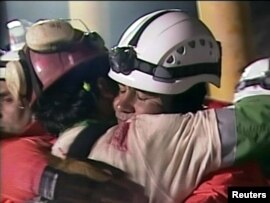 Psalm 130 is aptly called: A Song of Ascents. But never before did the psalmist's preamble ring so true. For this was literally an ascent the whole world shared.
"From out of the depths I call to you..."
From half-a-mile down, entombed in solid rock, held close in the tunneled underground of earth, the miners' plight called out to the world, and the world, led by the remarkable team of Chileans, responded.
"My soul waits for you as eagerly as the watchmen wait for the dawn."
As the miners waited for us, so we waited for them.
Who didn't - at some time over the past two months - stop in the midst of laughing or shopping or eating or walking or just feeling the sun on their skin and think, "But they are still down there!"
The rescue of the Chilean miners was, quite frankly, awesome.
Beginning with the moment after the collapse through the moment of freedom (and no doubt the continuing task of healing), the rescue represented the best of hope, generosity, persistence, planning, creativity, technology, and spirited resilience.
Whether the collapse was caused by negligence, greed, oversight, dereliction or bad luck is yet to be learned, and whether anyone is culpable is still to be investigated. That is tomorrow's task. Today we celebrate.
The leadership, the discipline, the fortitude, the compassion were inspiring.
Along with the extraordinary organization that the Chilean rescue team exhibited, people and companies from around the world vied for and delighted in helping: a special drill bit came from Canada; underwear and video equipment from Japan; rescue capsule designed by NASA; drilling bits and rig from Pennsylvania; rescue cable from Germany. And no doubt this is just the beginning of the story that has yet to be fully discovered and told.
It is too early to tell what painful scars or celebrated memories will stay with the miners, their families, the thousands who guided and worked on the rescue, the brave medics who voluntarily descended into the chamber, the millions who prayed and watched, the government officials. It is too early to know how the story will be re-told by the media, the filmmakers, the authors, the storytellers who are all no doubt lining up for the rights to get a piece of the tale.
But short of aliens coming down and attacking Earth, this concentrated drama has united the world in a rare moment of shared exertion, daring, hope and salvation. It has reminded us how fragile is our existence, how precious each breath, how similar we all are, how reliant we are on each other and how dependent we are on the comings-and-goings of the most basic elements life.
This drama has also caused us, once again, to wonder about what we do to underside of earth.
In mucking about below earlier this year, we caused the Gulf to spew forth its bounty from the Deep in a grotesquely gluttonous way.
In mucking about below this time, we caused the mine to swallow up in the Deep what is most precious to us in an equally grotesque way.
After we celebrate the glories and heroism of this moment, and there are many, after the dust settles and the miners go home, and we return to the quiet drama of our daily lives, we will need to ask: What have we learned about the price we pay for the way we choose to live?
Thursday, October 7, 2010
Bumper Crop
 There is a bench behind a church in Towson that overlooks a gentle 5-acre wooded landscape. Edging a garden made as part of an eagle-scout project, it sits atop land that, languorously at first and then more steeply, slopes away.
This is a seductive forest, clear enough of underbrush to lure your sight deep into its retreating woods, yet thick enough to offer a tantalizing whiff of danger.
It boasts mature trees and babies, 2-foot diameter elders surrounded by 2-inch diameter saplings.
And it was there, at the edge of this forest, sitting on this bench, that I found myself dwarfed, surrounded, inundated and swamped by acorns. Not the normal bunch that might fall in a particular spot in an ordinary year in the season of fruiting. But dozens, hundreds, even thousands of them. On the bench, on the walk, on the forest floor before me, not to mention those still precariously dangling above.
Anyone anywhere near an oak this year all along the eastern portion of the United States has noticed that there is something up with these trees: they have mass produced the seeds of their offspring!
Such an occurrence happens in a mast year, when all the trees of a certain species produce nuts in great profusion. Why or how they manage this synchronized surfeit is still something of a mystery. But here it is, this year, in an almost embarrassing display of fecundity.
How wonderful, though, to be reminded that life does not always unfold steadily, in sync with the plodding, predictable, metronomic constancy of time.
Most of the time, we go along, day after day, week after week, even year after year, doing the predictable; not surprising or astonishing ourselves, or anyone else in any way. There is the comfort of dependability in that; an air of expectation and fulfillment that we need as we negotiate past the many potential hazards of life.
Yet, on occasion, predictability can feel boring, even oppressive. The truth is, that while society needs systems that are built upon reliability and no surprises, it also needs to be goosed every now and then. That is how progress happens.
So blessedly, in unpredictable frequencies, for still-mysterious reasons, we discover one day that as we mindlessly reach for the rolls at lunch, we instead come up with great nuggets of discovery and imagination.
Life is not an even trajectory. It is bumpy, uneven, unpredictable, surprising. Who knows when our personal mast years (or even just mast days, perhaps mast hours!) will come. But come they do. And they are astonishing and energizing times of wonder. We cannot force them. We just have to be patient, continue our daily work, and wait for them. And then, we must celebrate when they come.
Meanwhile, go grab a bucket, fill it with acorns, and explore all the things you can do with them. Here are some tips to get you started.
Monday, October 4, 2010
Fired Up
 The holidays are over; the trick of cramming 5 days of work into less than 3 for weeks on end is now behind us.
And while I love the holy days, which never fail to bring me calm in the hours they are here (the gift of not being a pulpit rabbi!), the preparations and catch-up that frame them do tend to make the season a bit, shall we say, frantic.
It is, then, I will admit, often with a bit of relief that I bid them goodbye.
This year, just as we left the awe-filled realm of the mythic time of Tishrei and began crawling back into the routine of the everyday, the weather changed. Right on cue, after we returned to the world of leftovers, reheated food and eating indoors, fall's welcome cool set in.
This morning, in fact, it was downright cold. And it promises to be in the 40's again tomorrow.
Which can mean only one thing: time to fire up the stove.
I promise not to regale you too much this year with my wood cutting, splitting, trimming escapades.
But as I come out from under my holiday load, and return to my blog, I did want to share a photo of our first burn of the season.
With this simple act of setting our wood ablaze, my husband and I officially move from our "summer home" (the airy southern-looking sitting room) to our "winter home" (northerly and nestled up against the stove).
The move gives us a whole new perspective on the ways we live. It breaks patterns that stultify and recaptures the majesty and magic of "hearth" that our ancestors knew.
Some people swap out their summer clothes for their winter clothes. Some buy new shoes. We swap chairs.
Seasons signal necessary change amid the comforting constant. They bring new ways to be, to grow, to rest, to revive.
Seasons can signal us to change as well; to remove the routines that threaten to make us stale, encourage us to shift things around so that we too might better be, grow, rest and revive. It is good both for ourselves and for those people and things that are dearest to us.
So enjoy the brisk freshness of fall, and don't forget to change things up a bit.
Subscribe to:
Comments (Atom)