Tuesday, June 29, 2010

A muse on vacations

Humans, I would venture to guess, are the only animals in the world that take vacations.

After all, vacations, even the most modest of stay-at-home, curl-up-with-a-good-book-when-you-are-not-watching-the-Star-Trek-marathon vacations, are celebrations of planned and managed excess.

They are a coupling of the bounties of nature with the diligence of the human spirit.

They are, in the most profound sense, a blessing.

To be able to go away, to take a break from work, to rest and still have our daily needs fulfilled, requires anticipation and planning, graced by a gathering of excess time, effort, money, and stuff.

For us to enjoy our time off today, we needed to have had more than enough to store away yesterday.

Wars, illness, worry, poverty, deadlines, scarcity all deny the experience of vacation, for they do not allow us the luxury to pursue an abundant accumulation of good stuff.

The height of luxury is to be able to live - even for just a week or weekend - without work, without need, without worry.

How blessed we are when we can do that every year. And in Judaism how blessed we are that we can do that every week.

That is the gift of Shabbat, a weekly vacation of gathered abundance, appreciation and rest.

Both the annual and the weekly rituals are great joys; both are great blessings. The question they raise is, do we rest so we can work again; or do we work so we can rest again. Or perhaps, in the best of worlds, we do both?

May you be privileged to enjoy both this summer.


(photo of my son at a beach in Delaware)

Monday, June 28, 2010

Growth Pains

In his book, Ceremonial Time, John Hanson Mitchell writes of the attitude we need if we are to overcome our habit of excessive consumption:

The concept of material gain, of the acquisition of goods as a way of life, would have to give way to a smaller, more focused understanding of the essential needs and the essential pleasures that make up a well-lived life. The understanding that less is in fact more would be of paramount importance… and the people would have to understand at a deep level that the essence of civilization is not the multiplication of wants but the elimination of needs. (p. 219)


And I would add, the daily possibility of discovery and delight.

Compare that sentiment with the April G-20 Pittsburgh statement, which the recent Toronto G-20 gathering built upon.

12. Today we agreed:

13. To launch a framework that lays out the policies and the way we act together to generate strong, sustainable and balanced global growth. We need a durable recovery that creates the good jobs our people need.

14. We need to shift from public to private sources of demand, establish a pattern of growth across countries that is more sustainable and balanced, and reduce development imbalances. We pledge to ... promote adequate and balanced global demand. We will also make decisive progress on structural reforms that foster private demand and strengthen long-run growth potential.


Toronto reinforced this emphasis on growth, as this headline from the Wall Street Journal proclaims:
JUNE 27, 2010, 8:18 P.M. ET

UPDATE: G-20 Says Growth A Priority, But Action Needed On Deficits


Seeking to heal the economic wounds of the world is a necessary priority for the leaders of the most-developed countries today. Without a doubt. And seeking ways to provide jobs for everyone is essential. No one should be unable to contribute to the global pursuit of happiness and well-being. And no one should be unable to provide the same for themselves.

But, there are two essential elements missing from these statements:

1) a more expansive understanding of the concept of "sustainability", and
2) a better explanation of the sort of jobs we should be talking about

The April G-20 statement uses the word "sustainable," a buzz word for "environmentalists", but in a narrow, economic context. For the G-20, sustainability means creating stable, robust market and financial systems that allow continuous, uninterrupted growth world-wide. For them, unfortunately, growth seems to be the essence, the gold standard, the only way to prosperity.

Regrettably, it isn't. The truth is that unchecked growth will lead us precisely where they don't want us to go: to resource and energy shortages, higher prices for everyday commodities, food and water crises and overall civil unrest. (Herman Daly, a professor at our very own University of Maryland, is considered the founder of the field of ecological economics, which challenges the assumption that the contemporary economic theory of growth is the panacea for all that ails us. He speaks of the reality of limits and the dangers of growth, and promotes the idea of sustainable "development" instead.)

When "environmentalists" talk about sustainability, we most likely mean two things:

a) living well today in such a fashion that does not diminish the ability of future generations to live well also. That is, we do not want the cost of our good life today to be bought at the expense of another's good life tomorrow. We should not, by our reckless choices of excess, force our children to live a diminished life, with diminished resources, and diminished dreams.

b) that three elements are interwoven in the concept of sustainability: people, planet, prosperity; or earth, economics, equity. However you want to say it, sustainability includes the three domains of economy, ecology and social well-being. No one of these can be sacrificed on the altar of the other, not only because that would not be just, but because ultimately, it would fail.

To talk meaningfully about a sustainable economy, and to imagine that that involves social well-being for all, the G-20 must also worry about the environment.

While no one can argue that we need to build an economy that affords everyone a job, the question is, what kinds of jobs?

There is an abundance of need in the world: mouths to feed, children to teach, people to comfort, illnesses to heal, bridges to build, discoveries to be made. Whether locally or globally, we do not need, and cannot abide, jobs that continue to raid the earth of disappearing resources; jobs that dump toxins into the commons we all rely upon (our water, air, land); jobs, in other words, that continue the old way. We cannot defend jobs just because they are jobs. That will doom us all. We need jobs that tend to the calls of a needy world in ways that contribute to the world's health and renewal. If we did only that, there would be employment - and satisfaction - enough.

It always amazes me that when we talk about making changes for the sake of the environment, which ultimately means for the sake of people!, industries always threaten that it will cost thousands of jobs. Yet those very same industries will happily improve efficiencies, throwing thousands of people out of work, and smile as they watch their stock prices soar. They will shut down factories and send jobs overseas so their executive salaries will increase.

Indeed we know that while for the health and well-being of all, some job dislocation will occur. Some jobs will shut down. That is the inevitable way of development. But in this case, we also know that other jobs, even more jobs, healthier jobs, local jobs, will spring up in their place. It is our challenge to match these two sides of the equation so individuals don't suffer in the transition.

We are at the end of the old industrial revolution. That is a matter of fact, not a matter of choice. Our generation has been given the task of managing the transition from the old revolution to the new. We can do it well, or we can do it poorly. That is the only choice we have.

And in that choice rests nothing less than the fate of our planet and the welfare of billions of people.

Put that way, it hardly even seems a choice. So why do we continue to treat it like one?

Friday, June 25, 2010

The enchantment of fireflies

When we were very young, the witching hour came every evening in early summer, right around 8:30. We would finish dinner, have time enough for a game or two of SPUD, and then just as the sun was turning in, slipping under the covers of night, the enchanting, alluring, crepuscular, irresistible little beasties appeared. Fireflies. Only we called them lightning bugs back then.

They began the evening's graceful frivolities low to the ground, just a few of them at first. One here; another there. But slowly their numbers grew, and as they did, they rose higher, first shoulder height, then just above our heads, flashing their lights all the while.

It seemed all too perfect. We little ones, who were always too short to see the decadent delicacies over the bakery countertops; too short to reach the cashier's window-well at the movie theater; too short, it seemed, to reach all the good stuff the world was doling out, were just the right height to chase fireflies.

We were, on the whole, benign hunters; the catch-and-release sort. Except when we wanted to see if we could read by the light of a jarful of the creatures. Still, even these unwilling subjects were, after what must have seemed to them a torturous captivity, returned to the wild, apparently no worse for the wear.

This recurring, dusk-bound magical kingdom of cool, dancing lights was short-lived. So it had to be savored fast and furiously. By nine o'clock, the sky turned dark, and we were spent. It was time for bed.

Little did I know back then what I know now: that the show was just beginning.

I now live two houses away from my childhood home. That fact never ceases to amaze me, since the road from there to here covered many thousands of miles. Yet, here I am, decades later, trodding the same soil as those forefather fireflies I chased so many generations ago.

What I love most about the bugs who now share my spot of land is not their early emergence from the ground every evening. Rather, it is their later, lofty flights into the thick boughs of our towering trees. This happens after 9:00 pm, after the first stars are visible, after the children have gone to bed.

At this hour, the fireflies fly way past the outstretched arms of even the tallest adult, flitting amid the branches of our 120 foot beech and poplars.

Our front yard is a small meadow of grass ringed by bowery sentinels. Last night, my husband and I stood in the midst of this modest cathedral, watching the hundreds of fireflies put on their show, lighting up those leafy turrets, silently blinking on and off.

It is this stark combination of visual vibrancy amid absolute silence (save for the urgent calls of the frogs in our neighbor's pond) that is so captivating. It is odd for anything these days, especially anything so dynamic, to be so silent.

But they are, and so were we. We just stood there, as motionless as could be, holding our breath so as not to disturb the graceful drama unfolding before us.

It was enchantment. We were returned once more to that fleeting space of middle childhood we had left so many years ago, the place where the world sparkles and awes. But this time we came with adult appreciation.

After many minutes, filled with the vision of this once-upon-a-time place, we turned reluctantly, oh so reluctantly, and went inside.

(photo source unknown)

Thursday, June 24, 2010

Covenanting for Creation

At 5:30 pm, Tuesday afternoon, June 22, 2010, one sunset past the summer solstice, at the Bolton Street Synagogue on the banks of the Stony Run, nine religious leaders pledged their "commitment to honor the covenantal relationship that, in the teaching of each of our traditions, exists between God, humankind and creation."

Before 70 witnesses gathered to hear their words and celebrate their deeds, these leaders promised to work within the Presbyterian, Episcopal, Catholic, Friends, Methodist, Baptist, Muslim and Jewish communities to bring healing and justice to the ways we treat this earth and each other.

They signed a covenant, which in part says:

We stand at a crossroad. God’s word of covenant with land and with each other calls us to turn from our path of unrestrained consumption and careless disregard of the integrity of creation, and guides us to the straight path, where the good way lies. Religious communities must lead the way.

We must remember how to be full without excess, how to be satisfied with enough. We must find delight in ways of living that confer well-being on all people and all creation. Today, in the presence of God and one another, we commit ourselves to walking the path of covenant by sharing God’s blessing with justice and compassion so that all creation and all people may thrive together.


This program was hosted by Bishop Eugene Sutton of the Episcopal Diocese of Maryland, and coordinated by the Chesapeake Covenant Community (www.chesapeakecovenant.org), which itself has been influenced by our successes at the Baltimore Jewish Environmental Network.

It was a most moving - if very hot - afternoon. And it was hopeful. The common need for clean water, breathable air, sufficient food, affordable energy, open spaces, life-giving trees and near-by walkable places that refresh the spirit, offers a way to unite us all.

We must urgently seek these goals together, or else, I fear, when things get tough, when resources become scarcer, when fuel and heat and food and commodities of all sorts become more expensive, when the divide between the haves and have-nots becomes unbearably inequitable and unjust, which may be much sooner than we imagine if we don't work hard now to prevent it, we may no longer be standing shoulder to shoulder but grabbing at each others' throats.

Though actions create the condition of the world, and values create the impetus for actions, the human spirit creates the birth of values. The equation is clear: from spirit to values to action. Which is why religious communities must lead the way.

On Tuesday, the Baltimore religious community pledged to do just that. Now, we need your help to pursue our pledge. Visit the CCC website, sign the guest book, be in touch, join in the covenant.

The world needs you.

(image of Stony Run from www.griaonline.org)

Tuesday, June 22, 2010

Summer Solstice 2010

Fourteen hours, 56 minutes and 21 seconds.

That's how long the day was yesterday. The sun rose in Baltimore at 5:40 AM and set at 8:36 PM.

Compare that to the number of daylight hours on the shortest day to come in 2010: 9h 24m 00s on December 21.

That is the gift of the summer solstice. Seemingly endless sunlight, giving us almost two days of sunlight to every one in the midst of winter. No wonder our moods are generally better and we feel more buoyant and productive. We seem to have not just more light but more time.

But I write not just to celebrate summer days. I want also to cheer on summer nights.

Sunday night, we enjoyed the quintessence of summer: an outdoor concert in a neighborhood backyard performed by talented local musicians and friends.

Ken Kolodner, a magician on the hammered dulcimer who is perhaps best known around here for his annual Winter Solstice concert, welcomed some 70 folks to his home. We all brought our lawn chairs, a bit of wine, a touch of bug spray, slices of watermelon and a hunger for the music.

Six musicians serenaded us with ballads and reels on fiddles, mandolins, keyboard and guitar, not to mention the aforementioned hammered dulcimer. The selections were classics from the old country and some new compositions from just a year or so ago. One of the treats was that Ken also played with his talented son (a composer as well as performer). A sweet celebration of Father's Day.

Gathering on the second longest day of the year, at the moments around sunset, we were accompanied by the soft dance of night: the lingering, colorful fingers of sunlight slowly stroking the cheeks of the sky as they slipped down the side of heaven; the bats above - those still healthy and playful, swooping in time with each other, filling their bellies and ridding the neighborhood of pesky bugs; the fireflies, a whole army of them, which was great because their ranks were much depleted last year but this year they seem to have come back in force.

And this glorious moon as it showed itself between the thick boughs of this local urban forest.

It was the quintessence of a joyous summer's night. A pleasure to be at and a pleasure to remember.

For both you and me, may this summer's memories be full of such pleasures!

(This December is Helicon's 25th annual winter solstice concert. To celebrate with them, and find out more information, check out Ken's website at http://www.kenkolodner.com.)

(To find out more about time around the world, including local sunset and sunrise information, visit www.timeanddate.com.)

(I took this photograph in Ken's backyard during the concert.)

Sunday, June 20, 2010

Passing Time

This is a season full of personal and cultural fugits of tempus, sweeps of time's hands, clicks of the clock.

'Tis the season of weddings and graduations, house-buying and house-selling, moving in and moving out. For us personally it is, as you have read here, a time of loss, but also a time of celebration: birthdays and anniversaries echoed across multiple generations; expectations (new school, new jobs, new life, new place); satisfactions (deeds done, goals accomplished, pains soothed).

We are at a particularly thick spot in the weekly Torah-reading as well. Where peoplehood, connection, mutual responsibility, closeness and belonging seem riper than ever.

It was at this heightened moment, when we can almost hear the ticking of the universe's grand clock, that I ran across this poem, soulful and sad in its inevitability, yet comforting in the way it sees time running on... if we are lucky enough, and have worked hard enough, to be part of a community that proudly claims us, and whom we, in turn, delight in calling our own.


Translation

by Robert Morgan

Where trees grow thick and tall
In the original woods
The older ones are not
Allowed to fall but break
And lean into the arms
Of neighbors, shedding bark
And limbs and bleaching silver
And gradually sinking piece
By piece into the bank
Of rotting leaves and logs
To be absorbed by next
Of kin and feeding roots
Of soaring youth, to fade
Invisibly into
The shady floor in their
Translation to the future.


Happy Father's Day.

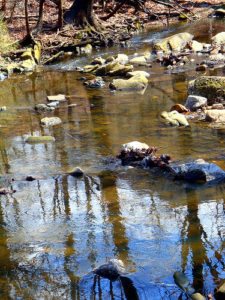
(The photograph is of wild woods I pass on one of my walking routes near my home.)

Wednesday, June 16, 2010

Watercourses


(Image of the Genesee River from www.tug44.org)

I was in Rochester this past weekend, helping to bury D., my sister-in-law's father. He was a scientist, with inventions and patents to his name, a long-time college professor, father, active member of his minyan, all the trappings of adulthood. And yet, deep inside, perhaps what most defined him, was his delightful, insatiable, infectious curiosity about the world.

He wanted to know what made things go; where the world kept its secrets and what they were. He loved poking around earth's physics closet, tickling it and prodding it and seeing how it responded, unraveling a code that had not been unraveled before. The sheer act of discovery was a gift to him.

But it would be even better if he could turn this newly-revealed tidbit from the world's satchel of secrets into something that made the world a better place. If he couldn't always do that, at least he could try to make it laugh.

It was a sad visit.

And then, we sat around and talked, four generations of friends and family, remembering, sharing old photographs, telling stories so familiar they were threadbare from use and stories so new they needed to be kicked around and scuffed up a bit to be claimed as our own. The photos and stories made things a bit easier. Still, moments of profound and irreversible loss burrowed themselves deep into us.

At dinner, I got a wonderful email from my daughter-in-law: a copy of a sonogram of my five-month old, gestating, grandchild-to-be. A rapid journey from tomb to womb.

It was a day of over-flowing emotions. And it seemed to be anchored by two water courses.

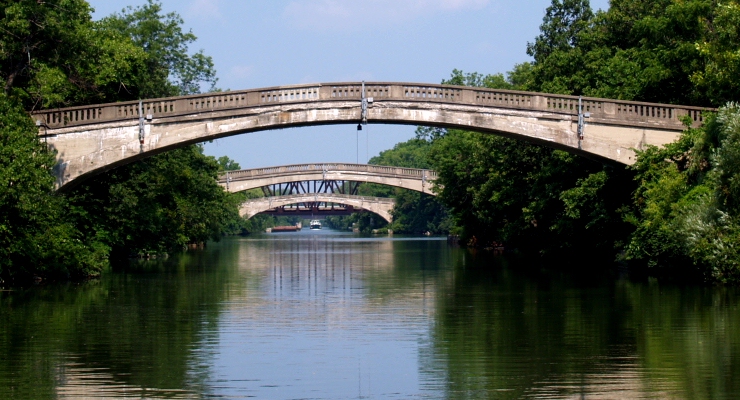
On the way to the cemetery, we passed over the historic Erie Canal. Twice. Built in only 8 years in the early 1800's, the canal ran 363 miles from Albany to Buffalo (and the other way around), allowing unimpeded water transport from the Atlantic to the Great Lakes. It cut transport costs by 95%, enabling Rochester and communities west of the Hudson to thrive. It was the kind of invention and gumption, the copying and harnessing of the world's secrets of water channels to improve the way of life without damaging the earth, that reflected D's passion.

The canal is almost 200 years old, still kept in good shape in the Rochester area at least, still servicing the spiritual and recreational life of its people. And the water still flows.

The hotel we stayed at was neighbor to a second water course. Our room overlooked the meandering Genesee River, a dynamic river with its headwaters in Gold, PA, and waterfalls all along the way, ultimately emptying and exhausting itself in the open arms of the great lakes.

I found the waterways soothing - comforting. Sometimes, as we looked out our window or stood on the bridge crossing the Genesee, it was hard to tell which way the water was flowing: toward the open lake or back towards its source. The surface of the water seemed to be fighting with itself, forward or backward, reaching ever onward or turning back to grab one more piece of the past.

It seemed to capture our quandary.

Of course, it always flowed to the lake. It had to. Physics demanded it, as life demands we move on. And there is something comforting in that.

For we know that like water, we too are never static. Like the untold number of droplets that are the stuff of streams and rivers and lakes, we too are always moving, coursing through the world, bonding to those near us, shaping the banks and beds by our presence as we roll by, ultimately meeting in a grand reunion in life-giving bodies that nurture the world.

And then the story begins all over again. With the clouds that signal the cycle continues, and the vaporous glimpse of the sonogram.

Friday, June 11, 2010

Glacial Envy

I feel cheated. Glaciers have a magical hold on the imagination. They are inert masses of water and ice that lumber blindly along, yet they also calve, give birth to smaller bits of themselves, and radically alter the landmasses under and around them. They are both behemoths and vulnerable; domineering and ephemeral. As John Larson Mitchell suggests in his book, Ceremonial Time , glaciers act as the hand of God, powerfully fashioning the surface of the earth.

But here's my beef: Maryland never had glaciers, at least not in the last glacial period which peaked a mere 20,000 years ago. They never made it this far. They just nipped to the north of us. Which is why most of America's lakes, especially our large ones, are in the northern part of the northern hemisphere. Because most lakes were carved out by glaciers. And we didn't have those big chunks of ice milling around down here.

We have no kames or drumlins or other geological features with cool, middle earth names. And no natural lakes.

There is nothing to be done. Laments won't help. But there it is. I just thought I would share.

Here is some information from the Maryland Geological Survey about lakes:

Q1: Is it true that Maryland does not have any natural lakes?
A1: Yes, there are no natural lakes in Maryland. All of Maryland’s lakes are man-made by damming rivers. Some have been named lakes (e.g., Lake Habeeb in Allegany County and Deep Creek Lake in Garrett County), but most have been named reservoirs (e.g., Loch Raven Reservoir in Baltimore County).

Q3: Why are there no natural lakes in Maryland?
A3: There are about a dozen major types of lakes, meaning there are about a dozen ways lakes form. None of those is found in Maryland. Some 74% of all lakes are glacial in origin, but glaciers never entered Maryland during the last Great Ice Age. Glacial lakes may form in bedrock depressions gouged out by glaciers or in areas where detached blocks of stagnant or retreating ice sheets are surrounded by other glacial deposits, such as sand and gravel outwash. When the blocks of ice melt away, the remaining depression, known as a kettle, may fill with water to form a “kettle lake.” Other major types of natural lakes include those that result from faulting, volcanic activity, and landslides blocking a river.

For more information about Maryland's land, visit http://www.mgs.md.gov/, Maryland Geological Survey.

Solo Cup Company

The Solo Cup Company announced this week that it will be closing its plant in Owings Mills as of 2012. Our community will lose a solid neighbor, 540 jobs and a staple of our urban landscape for over 80 years.

But this departure also offers us a chance to think large about small things.

The Solo Cup Company cleverly chose its name way back when to describe the purpose of its singular product: single-use. Having a dinner, a snack or a wild party? On any occasion, just bash and trash.

How irresistible it must have been. In an era when the resources of the world still seemed full and ripe, when memories were painfully fresh of thousands of soldiers dying of infection in the trenches of World War I, when new meant clean, when technology beckoned us toward a more leisurely way of life, the Solo Cup Company introduced a revolutionary product: something you could use once and throw away.

Far beyond its imagination, it would help inaugurate a century and a culture of disposability.

Their mission statement says it all: "Solo will be the company that enriches meal occasions and simplifies life with single-use products that our customers and their customers see as indispensable."

No muss, no fuss. Make a mess, dirty things up and then just throw it all away. You are worth it. The world can take it. Free your time for greater things.

I am sure it sounded like paradise. The vision it offers is one of great abundance: endless resources to feed our endless desires; a bottomless "far away" to hide our mountains of trash; and for women, the extra flattering message that we are valued as more than mere housewives and therefore are now freed from the tyrannical grasp of constant cleaning. (Though for those of us who do our best thinking or most intimate talking over the mindless task of washing dishes, this could be a problem.)

Now, I very well may be mistaken, but I sense that even Solo's proud entrepreneurial geniuses felt a bit uneasy about their invention, as if they knew something in this was amiss. After all, they didn't say that single-use products ARE indispensable, or must become indispensable. They say that single-use products are seen as, perceived to be, indispensable. I see a huge, if unintentional and subtly revealing, hedge in their words.

Compare their mission statement above with this potential version: "Solo will be the company that enriches meal occasions and simplifies life with single-use products that will become indispensable."

And in that little hitch, that "see as" vs "will become", lies the promise and the challenge. It is as if even their own founding fathers, raised in a world of hard work, durability and frugality, could not fully embrace the emerging desires of the world they sought to exploit.

Today, this company that championed trash has leavened its culture of disposability by introducing a new line of sustainable products. Perhaps this is their first step back to recapturing the values they felt they were betraying at their birth. Perhaps soon they, like all other 20th century legacy companies, will choose not to introduce piece-meal green product lines, simply to pander to a strong segment of their consumer base, but rather truly embrace the imperative of sustainability and choose to run their entire operation with sustainable resources and practices, because it is both right and ultimately, the only economical way to run a business.

The question before us now is: what will be done with the Solo property? Perhaps it can be turned into a green educational center for schools? a local park? a suburban orchard? a collection of studios for artists and green craftsmen?

Let's think imaginatively and perhaps begin a dialogue with Solo, and see how their departure can endow us with even greater good.

Tuesday, June 8, 2010

Heartwood

There is much to be learned from the inside of a tree. The lessons begin with its colors, distinguishing the heartwood, which is dark, and the sapwood, which is light. The one for stability and the other for nourishment. The yin and yang of constancy and growth, pause and movement, stasis and change.

But such a distinction is a bit misleading, for it makes us think that each wood is created as one or the other from the start, just as we are created male or female from birth, or parts of our body are created muscle or bone. But that is not the way it works with wood.

Wood changes. The heartwood, the solid core, begins as sapwood, the fleshy rim. The softer sapwood's destiny is to become, in due time, the hardened heartwood.

Sapwood grows anew each year, porous and pliant, allowing water and nutrients to travel from root to leaves and back again. When the tree is young and hungry, all its wood is sapwood. Supple, flexible, fluid it responds to the lusty demands of youth.

Youth enjoys and needs voluminous energy; an abundance of freedom; an exaggeration of movement. It is a time of impulsiveness, vulnerability, enormous appetites for tasting the world. (I still speak of trees here though there definitely seems to be a slippage into the realm of people!)

But as the tree grows, its needs change. Height and maturity demand structure, something reliably solid, fixed, and dependable. An overabundance of sapwood would make the tree bloated, grotesquely voracious, a doughy blob that clogs and strangles itself through excess consumption.

So the wood changes, morphs, in response to two needs: a reduction in the proportion of nutrient consumption and an increase in the demand for structural support. The sapwood turns into heartwood, apparently rather abruptly (the line between the two is narrow and distinct), moving from consumption mode to stasis mode, as inexorably as children turn into teens and teens turn into adults. (Sometimes the change in people is as surprisingly rapid. Other times, not.)

But something even lovelier happens. Moving from sapwood to heartwood is not just a process of hardening; it is a process of beautifying and strengthening. The chemicals and "extractives" that accumulate in the sapwood transform the wood in two additional ways: they protect it from decay and infestation, offering a defense against disease and decay; and they confer upon it its classic coloration. Cherry, walnut, oak all get their coloration, their distinctive beauty, from this process of maturation.

This aging, this hardening, this dying of sorts, is not an aspect of decrepitude or decline, but a necessary part of health for the organism as a whole.

I had planned to write on this topic today anyway, but the thoughts here gained greater urgency and intensity when I learned that my sister-in-law's father passed away yesterday.

He was a fun man, one of those fellows with a bottomless satchel of jokes, riddles and puns. And he was a man of great accomplishment, although he was too modest to let you know. He helped invent memory wire, an invaluable material in medicine and space industries, never mind costume jewelry!

His aging was difficult, his death a true loss. And yet his life, his legacy, his memory serve as our heartwood. His sapling years gave us much novelty and growth, but they are now gone. Still, his heartwood years live on. I know my sister-in-law and her family remain buoyed and steadied by the strength this core offers. How wise that it is called heartwood.

(the photo above is a cross-section of the tulip poplar we had to take down)

Monday, June 7, 2010

Old Friend

We cut down a tree two weeks ago. A whole one. A big one. We had to. It was listing to one side, lifting up the soil as it loosened its grasp upon the earth, threatening to fall right where we park and walk everyday.

We were, blessedly, out of town when the deed was done. This had been a mighty tree. No shimmying up its spine to cut it down bit by bit. No lone cherry-picker would have worked. This tree needed BGE to disconnect the wires to our house and a crane to lower its upper portions safely to the ground.

We asked the workmen to leave the wood behind. We could use it for firewood, we said. It burns too fast for that, they said. Still, we said. This is its home. Leave the wood. So they did.

We came home to the sight of the tree, downed and defeated. This once-grand monument lay in heaps upon the ground. The land it had swayed and swaggered over now had become its silent resting place. Such is the way of trees.

It seemed astonishing, as I thought about its years, that the tree stood so long in one place yet never touched the ground that gave it life. (The roots, of course, are part and parcel of the soil, but I refer to the tree as we see it.) How strange to be so close, so intimate, for so long and never to fully touch. Did it ever yearn to reach down with its branches and stroke the grass beneath it? Did it ever have the urge to bend its straight and towering trunk so it might smell the rich soil that fed its expansive roots? But the union, the touching, came in the end. The circle is complete - the tree ends where it began.

For the first time, too, I could touch the tree. All of it. Bark that was stories above my head last winter now lay at my feet. I got my tape measure. I wanted to know the size of this monument. The trunk was 36 inches in diameter, one of the largest and oldest trees in our woods. The tree stood 100 feet high or so at its peak and was 80 years old when cut. I counted the rings, the fat years and the skinny years.

The tree seeded in the dark days of the Great Depression. It became a sapling as the country clawed its way to recovery. It sunk its roots deep as we went to war. It spread its branches high during the years of Camelot. It stood firm on this street as I - in my youth - rode by on my bicycle, chased fireflies on a lawn across the way, visited the neighbors right next door, and wrestled, as children do, with becoming myself. It knew me, saw me, before I knew myself, and before I paid any attention to it.

Now, it was left for me to take it down, and dispose of it well. If I were handy, I would make from its wood a coffee table for my living room; cribs for my grandchildren; a chair for my husband; a podium for my mother; many bookcases for my office and a desk for my work. And I would still have wood to warm me this winter.

Perhaps I can find a woodsmith to help me. That way, the tree can live another 80 years.